“The Long View” art exhibit at Suffolk University’s gallery closed April 3 after three installations celebrating women artists in the studio. The last installation opened March 2 and featured artists Sharon Kaitz, Alyson Schultz, Jo Ann Rothschild and Maggi Brown.
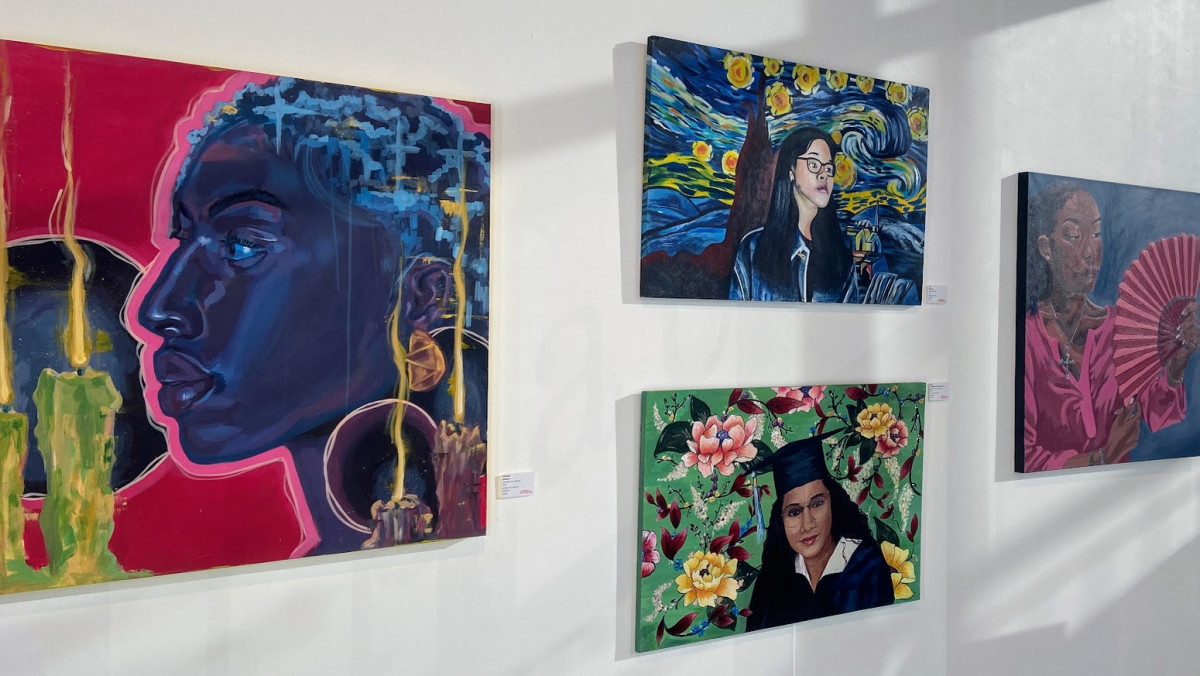
The exhibit displayed bold pieces of every size, which took the viewer on a journey around the gallery.
Taking up most of the right-hand wall were three of Schultz’s “Fracture” series, each including six 24-by-24-inch canvases. Directly to the left was a winding trail of “Various Small Paintings” and “Variable Small Works” by Kaitz. Across from this, pieces spanning five years in time by Rothschild grew along the wall.
The exhibit sought to honor artists who have sustained lifelong studio practices, according to the exhibit description. The women featured are all from the Boston area and still create art today.
Brown said she has been mark-making, “since [she] was able to hold a pencil.”
She specializes in painting, but also enjoys other types of drawing. She has many influences for her work and gains inspiration from different outlets.
“As far as influences go, color is of great importance in my work. The expression of color and what it says in its own right,” said Brown. “[Also] the reconciliation of opposites. I feel that one needs beauty and disturbance that creates attention so that the beauty can be appreciated.”
The exhibit description said that the exhibit honors “artists who have sustained lifelong studio practices — artists who continue to create, explore and evolve.”
Brown said she’s been doing art since a very young age, and sometimes she still feels those same anxieties she experienced as a child.
“I had my first show at the age of 12 when I graduated from eighth grade. Although looking back on what I had done for that exhibition — cute puppies and kittens in chalk drawings — the principal at the time was very taken with the work and had it framed at her own expense,” said Brown. “I found this very uncomfortable. I still get that sensation at an opening, especially to a solo exhibition. I’d rather run away.”
Bown continued making artwork, going on to study portraits, landscapes and professional painting. She worked in New Jersey and Maine, eventually moving back to Boston to finish school and get her Bachelor of Fine Arts at the Museum of Fine Arts at Tufts.
Brown said that her favorite piece on display at “The Long View” was “Lead Painting With Strings.” The abstract oil painting is a dull gray that features strings arranged in angular positions.
“It was done at a time when many artists were using lead in their work. I liked the way this work looked, but I didn’t want to use such toxic material. I struggled to create what I felt was the color of lead,” said Brown. “The strings that I use came from the canvases that I painted on.”
Schultz has lived and worked in Boston since 1983, after graduating from the Museum of Fine Arts at Tufts with her Master of Fine Arts. She balances careers in both motion design and fine arts alongside raising two children. As an artist, Schultz specializes in creating abstract art with oil on panel.
Schultz’s medium has changed over time.
“I was a printmaker through undergraduate school and for two years of my Master’s program, where I realized I loved drawing on the solid surface of the litho stone far more than the prints I pulled from it,” said Schultz.
Schultz draws inspiration from the urban environment to construct her abstract paintings. She described this in her artist statement.
“The genesis for my work is the urban environ, more specifically the night city, graffiti, demolition, fire, windows, fences and walls,” said Schultz. “Each painting undergoes a history of its own, as layers are added, scraped, overpainted, built and rebuilt — the paintings evolve from depiction to a more personal, evocative terrain.”
Featured in Suffolk University’s gallery are three of Schultz’s “Fracture” series, which embody her ideas of the abstract urban landscape. She described her inspiration for creating such large pieces and the fluidity of how they can be arranged.
“My studio walls are only 8 feet high, and the series started as an attempt to create work that wasn’t bound by that restriction,” said Schultz.
Schultz has had her life impacted by art, which is why she continues to pursue it as a lifelong practice. “The Long View” is the perfect way to honor that ideology and continue to showcase her work.
“My studio practice sustains and completes me in a way that no other part of my life does. There is both a creative need to be in the studio and a commitment that fulfills in a way that nothing else does,” said Schultz.