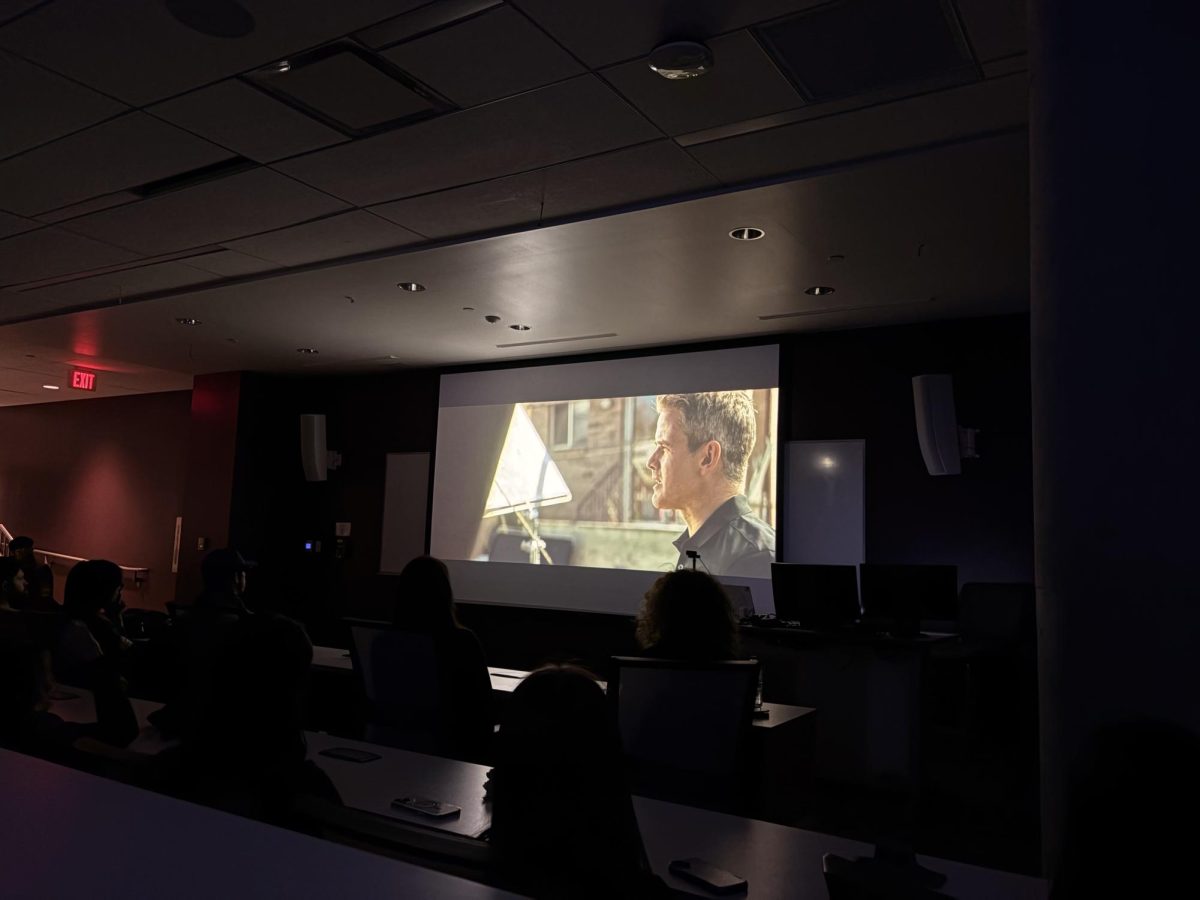
Former Rep. Adam Kinzinger put his career on the line to fight for democracy, for the America he believed in. Through his final 13 months in Congress, there was a camera crew following Kinzinger around to document what was later titled “The Last Republican.”
This documentary sheds a vulnerable light on the personal tribulations that unfold when a politician votes against their party to fight for something they truly believe in. “The Last Republican” depicts the aftermath of the Jan. 6 insurrection that occurred at the United States Capitol after President Donald Trump lost the 2020 presidential election.
Screened for a room full of Suffolk students March 17, the documentary was followed by a discussion with Kinzinger and the documentary’s cinematographer, Josh Salzman, who joined the event via Zoom. Facilitated by Shoshana Madmoni-Gerber, chair and professor of Suffolk’s Communication, Journalism and Media Department, and Rachael Cobb, a professor in Suffolk’s Political Science and Legal Studies Departments, the discussion served as a way to further a conversation around the current state of democracy in the U.S.
“The Last Republican” was a surprisingly funny film that addressed pressing and serious topics relevant to the state of the country. Director Steve Pink and Kinzinger’s witty banter throughout the film allowed the audience to really connect with the story being told. It becomes clear from the beginning that Pink and Kinzinger hold different political views, which is highlighted throughout the film. Because of this, the story expands from not only being about Kinzinger’s relationship with his own party, but the relationship between Republicans and Democrats and how that has shifted.
During Trump’s first presidential term, Kinzinger was praised by the president. He was an up-and-comer in the Republican Party and Kinzinger wanted that. But once Trump lost the race against former President Joe Biden, this illusion was shattered. Kinzinger saw that democracy and the Republican Party could not thrive, let alone exist, with Trump as the leader.
Kinzinger was one of the first Republicans to call for Trump’s impeachment.
This isolated him from the vast majority of the Republican Party as well as people in his personal life. Friends and relatives would call Kinzinger, saying that they no longer supported him and that he was a disappointment.
Kinzinger decided not to run for re-election, but then he was placed on the investigation committee for Jan. 6. He was one of two Republicans on the committee, the other being Liz Cheney.
Intertwined with the story of his service to the country and work on the Jan. 6 investigation committee, Kinzinger had his first child 11 months before leaving office. The documentary highlighted both the personal struggles he was facing at this time and the professional ones.
Throughout the film, Kinzinger did not veer away from his Republican identity, something that Pink and he often banter about.
“I’m not the one who’s changed. The party has changed,” Kinzinger said in the documentary.
The more Kinzinger spoke out against Trump and other members of the Republican party who were supporting him, the more of a polarizing figure he became. Major media personalities, notably Tucker Carlson, would talk about him frequently on shows and debate his loyalty and humanity as a Republican who does not support Trump.
His work on the investigation committee drew attention to the unjust actions of rioters and the president. There were moments of hope that Kinzinger felt throughout the process. But it was clear that they had lost when Republican Speaker of the House Kevin McCarthy dissolved the committee. Trump was re-elected and there would not be a further investigation.
Kinzinger spoke about how there was a missed opportunity for Republicans in Congress to create a historical moment; instead, they all stayed silent. And the more that he spoke out, the more isolated he became.
Kinzinger left office with a mixed reputation — some saw him as courageous for taking a stand and fighting for the America he believed in. Others saw him as a traitor.
“I don’t think I’m courageous. I’m just surrounded by cowards,” said Kinzinger towards the end of the documentary.
Suffolk students and faculty who were in attendance during the screening applauded as the former representative joined the room on Zoom and the second part of the event began.
Despite the very real and often frightening themes that were explored throughout the documentary, Cobb noted that it was surprising that people can leave this movie smiling.
Kinzinger continues to be an outspoken critic of Trump and emphasized the importance of coming out on the other side.
“This will be the end of MAGA. In three years, it will be the end of Donald Trump and everything. Trump has put his name on every building — The Trump Kennedy Center — all of that will be erased on Jan. 21, 2029,” said Kinzinger. “If I’m ever president, I’m not announcing I’m running, but that would be my very first executive order, to remove his name from everything but the history books.”
Students also got the opportunity to ask questions of Salzman and the logistics of filming such an intimate documentary in the U.S. Capitol.
Salzman said that the physical demands of filming could be challenging since it was a small crew in a very small space, often with little knowledge of what was going to happen. He said that he had to stay calm and focused, not only to get the shots that he wanted, but to understand what was happening in some of the meetings.
“As far as my political vernacular goes, it’s small. So I was learning as I was going. But also for me, in some ways that is what held beauty to it, because I didn’t walk into anything with any kind of preconceptions,” said Salzman.
Though there are many people worried about the future of American democracy right now, Kinzinger held onto one main point: Don’t give up. He sees a future past Trump that recovers from the policies and actions that have occurred and are invariably going to occur.
“Not a single generation of Americans have failed to get through very difficult times,” said Kinzinger. “We’re not being asked to sit in a trench; all we’re being asked to do is not give up hope. That’s our job. And they’re going to sing songs and write stories about what we did because we’re going to bear the ever living shit out of them politically.”