

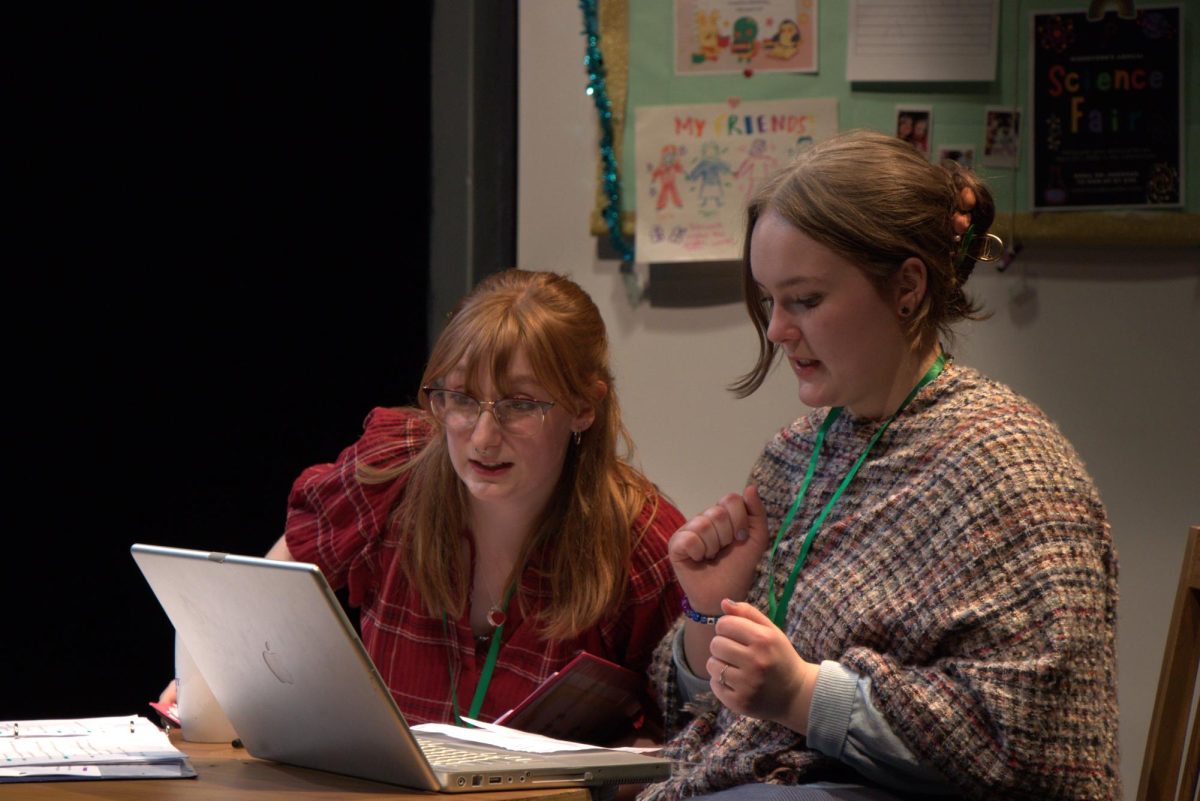
“Woodfern,” which debuted March 20 at Suffolk’s Sullivan Studio Theatre, follows the teachers of the fictional Woodfern Elementary School as they fight to get supportive services for a child they believe likely has a learning disability. Leading this is Teresa Hughes, played by Audrey Smith, the child’s main teacher who is close to retirement, assisted by a couple of younger fellow teachers, played by Kay Gillespie and Maddie Palombo.
Together, they work through an underfunded school district led by an unfriendly principal (Matt Killion) and a sympathetic, yet similarly unwilling district coordinator (James Butler). Interschool politics play a role as well, as a jealous teacher (Maximus Barboza) also tries to derail their quest for funding while trying to get a role in the administration himself. Ultimately, the play concludes unresolved, after those in the school’s administration refuse to fight for the funding themselves.
The play was inspired by the grandmother of director and playwright AJ Aversano. Aversano, a senior theatre major, described their grandmother, who was an elementary school teacher for 32 years, as a strong advocate for students with learning disabilities, much like Woodfern’s protagonist.
“She was a fierce advocate for learning accommodations for students with learning disabilities so much that when she passed away, students from across the 32 years that she taught came to the service,” said Aversano. “I met a handful of them at her wake, and they told wonderful stories about her, and I felt that she needed to be commemorated in some tangible way.”
Combined with that was inspiration from the current political climate, which often finds funding for special education services, such as for learning disabilities, under threat. Such funding cuts were referenced throughout the play, and Aversano made it clear that it was a direct catalyst for “Woodfern.”
“At a time when funding for education is being cut and support systems like IEPs and 504 plans are increasingly under threat, this story feels especially urgent. These programs are often treated as expendable, but they are lifelines. They are the difference between a student feeling incapable and a student being given the tools to succeed,” Aversano wrote in the playbill.
“Woodfern,” as part of the Theatre Department’s Spotlight series, was actually a staged reading of a play, which is a frequent step plays take before getting a full production.
The only noticeable difference from a typical play is that the actors carried their scripts with them throughout the play, due to having less time to memorize the scripts. Despite this, a lot was still well-integrated into “Woodfern,” including many scene changes and stage directions throughout, which Aversano attributed to the actors involved.
“My cast was so easy to work with, and they were rocking and rolling with me the entire time. We would change things, we would add things and they are professionals,” said Aversano. “It is so easy to work with them. And they were so on board with everything and passionate about it from the jump.”
Aversano and the cast of “Woodfern” will be back for the next play in the Spotlight series, “Symbol,” which Aversano described as a dark comedy very different from “Woodfern.” It will take place April 17 at 5 p.m. at the Sullivan Studio Theatre.
















School of Computing • Mar 26, 2026 at 5:16 am
What is the central issue the teachers at Woodfern Elementary are trying to address in the play?