The “Of Light and Air: Winslow Homer in Watercolor” exhibit opened at the Museum of Fine Arts Nov. 2. Under purposefully dim lighting and deep within the underbelly of the MFA, Winslow Homer’s art finally takes a place in the limelight.
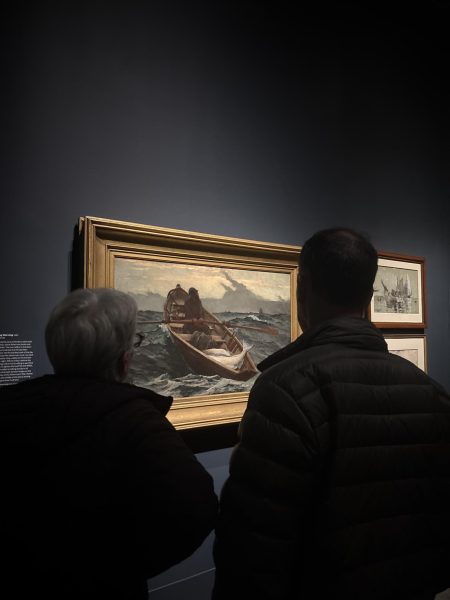
The MFA was one of the first museums to acquire a piece of his work, starting with his painting “The Fog Warning” (1885). From there, the museum continued to collect his work, amassing a whopping 50 watercolors and 11 oil paintings, leading them to house the largest collection of his work in the world.
Due to the delicate nature of watercolor paintings, which are particularly fragile under long exposure to light, this is the first time in nearly half a century that all of these works have been displayed.
The exhibit opens with Homer’s most iconic watercolor, “The Blue Boat” (1892). This is the one used to promote the entire exhibit, with good reason. Homer’s ability to express such extensive detail using watercolors, the same medium given to children to introduce them to painting, is splendid.
There is something fluid in the watercolor, maybe it’s something in his ability to make such realistic reflections in the river or maybe it’s something in his ability to capture the ripple effect the canoe and paddle have to the water.
From there, the next room is splattered with sketches Homer did. Though, just because they are sketches, it doesn’t make them any less detailed or artful than his watercolors or paintings. This room is titled “Origins,” marking his beginnings as an artist. Homer’s dedication to art is otherworldly, clearly a lifetime endeavor that he was devoted to.
While his watercolors are where his passion clearly was, Homer’s oil paintings are nothing to shy away from either. If you thought his detail with watercolors was spectacular, his detail with oil paints is immaculate.
The majority of the paintings were of foamy waves crashing against sandy beaches or shining scenes of boats coasting along within the harbor. Homer spent some time in the Caribbean, bringing a noticeable shift of brighter and lighter tones to his coastal paintings.
The last few sections were dedicated to Homer’s time in the Adirondack Mountains, a deep emerald green motif flowing through all the works in this subcollection. One of the most jarring is “The Fallen Deer” (1892), a detailed watercolor of a killed deer, its nose and legs partially submerged in the river where it spent its last moments. Once again, Homer’s ability to reproduce reflections within water using watercolors is beyond impressive.
Very rarely does Homer’s works not include some human element to them; the occasional young boys playing under the docks to delicately dressed young ladies, with their dresses swaying in the wind. His typical focus though remained on the working class; from hunters to fishermen to farmers to the many guides through the Adirondack Mountains, through the Caribbean towns, through the New England waters.
The exhibit ends with a final oil painting and watercolor of what was undeniably the muse of his art – the sea. These two arts were made more than 23 years apart, but Homer’s perfection of his ability to paint the water in such detail makes them seem like they were done days apart. Despite the two different mediums and many years separated, Homer’s skill overcomes whatever barriers may have been there, much like the tide overcoming the beaches.
Beside these two paintings, etched in the walls is Homer’s handwriting: “turn, turn, tumble,” on one wall and “tumble, tumble, turn,” on the other. These were the same words Homer had scratched into the walls of his studio in Prouts Neck in Scarborough, Maine, this sort of mantra that he must have used to paint waves as they tumbled onto the beach.
At one point, Homer said, “you will see, in the future, I will live by my watercolors.” And boy, was he right. He is a masterclass example in dedication to the art of watercolors and oil painting, making his collection of work a must-see. The “Of Light and Air: Winslow Homer in Watercolor” exhibit will be open until Jan. 19.