Though West Newton Cinema is slotted in a near-desolate nook east of Boston, and frigid wind picked up the unforecasted snow, already fluttering in, the moviehouse was an inviting, warm environment, ripe with the chatter of family and friends, a welcome antidote to frozen-numb ears.
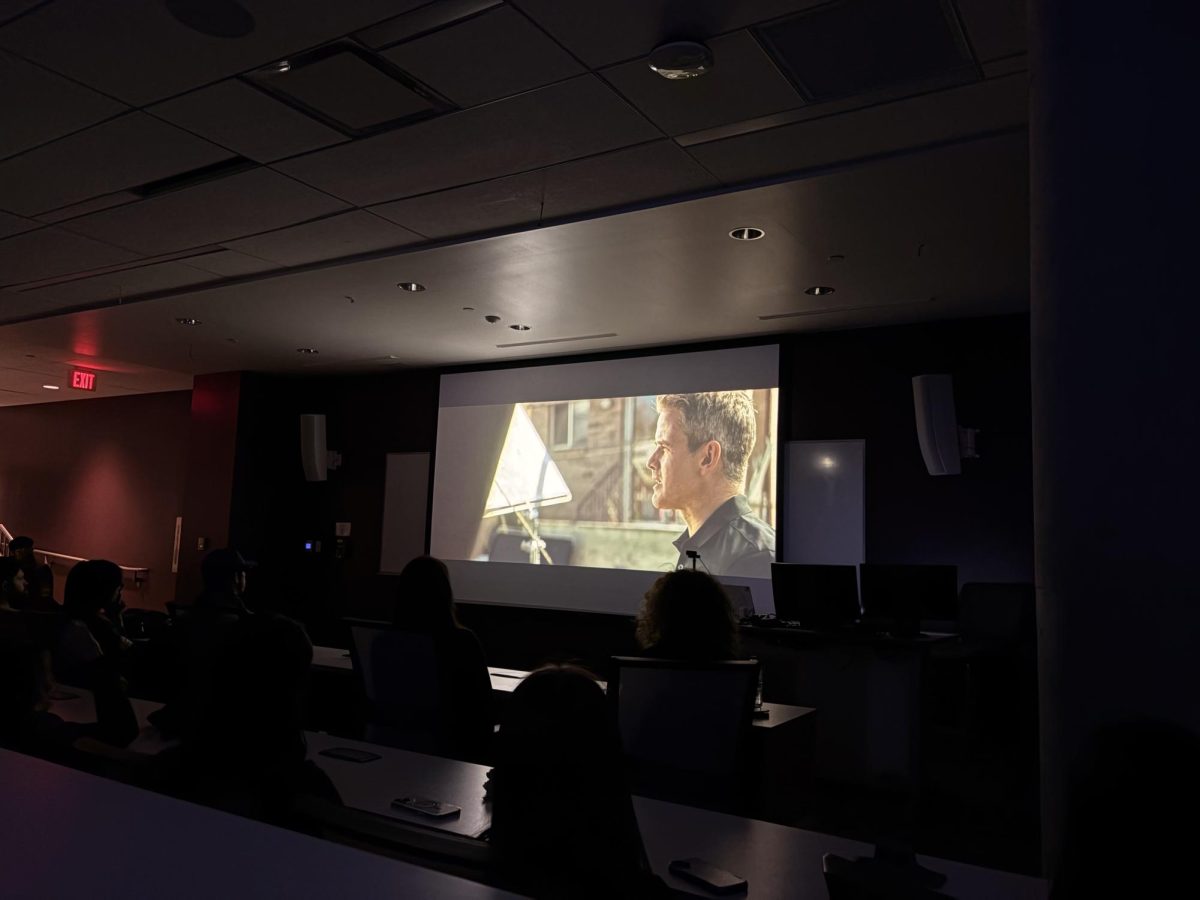
On Dec. 4, filmmakers Jeremy Levine and Rachael DeCruz showed contextual clippings of their film “NINE” at the West Newton Cinema.
Levine works as an assistant professor in the communications, journalism & media department, teaching visual aesthetics and production courses. This is his and DeCruz’s second project together, following their 2021 short film “The Panola Project,” the story of Dorothy Oliver helping her rural-Alabama community gain access to the COVID-19 vaccine during the pandemic.
“NINE,” which was originally set to be a book by DeCruz, is a masterful display of what both people and film can do. DeCruz and Levine show us that a documentary can be so much more than a Ken Burns slideshow of archived photos with a voiceover — more empathetic, emotional and teeming with life.
At the center is Gerald Hankerson, former leader of the Washington state NAACP, who has spent the years since his release from prison working to help those still incarcerated. Hankerson was sentenced to life at 18-years-old, and served for 22 years before receiving clemency. He made a promise upon being released that he would not leave behind those imprisoned, and he has fought to push legislation that encourages racial equity in the criminal justice system.
“NINE” is also about Henry Grisby, a man who has served over 40 years in prison, his fight for freedom and the bond between him and Gerald.
What is special about “NINE” is how it resists the manufactured feeling of many films — well-shot and alive. But it doesn’t feel the need to build a world or characters where they already exist with so much zeal. It is without interviews and reaches an audience the way a narrative film might, through visual poetry and intimate composition.
On the choice to exclude interviews from their documentary, Levine stated that “Gerald is the expert of his own story.”
DeCruz talked about their involvement with the events as they unfolded.
“We were very conscious of the role of the camera,” said DeCruz.
“The Panola Project” and “NINE” are both distinctively stylistically sound — not what a person typically thinks of when hearing the word ‘documentary.’
DeCruz and Levine found a very unique tone for “NINE” — it condemns the systems that allow for so many people to fall through the cracks and suffer as a result of both negligence by the state and oppression actively working against them, but is still so well-rooted in family and hope that the film maintains an almost uplifting tone.
In “NINE,” we see Henry positioned against a row of telephones in the prison, or Gerald’s car in the parking lot, with sprawling space almost swallowing him. Still, there is color and life in each frame; as we follow Gerald’s granddaughter on a scooter, Henry’s wife on the phone or a group of formerly incarcerated men whose lives were touched by Henry, and their unifying hope for his release.
Despite its critique of the criminal justice system, “NINE” remains remarkably gentle. There is no choice for this story to be treated with anything less than the care that DeCruz and Levine have.
Levine talked about the visual choices made in the film that add to this tone, and “having these extreme wide shots,” and “this sterile kind of symmetry of these structures, and seeing Henry onscreen small against this massive system.”
“It’s both, right? It is this massive system that has kept him in prison for 45 years. And yet, there is a way to push back, and that is based in the strength that [Henry and Gerald] find in each other,” said Levine.
There’s a scene in the film where the Black Prisoners’ Caucus asks Gerald what they can do, since, as incarcerated men, they do not have the ability to vote. “NINE” is good at reminding audiences exactly how to mobilize outside of simply voting. Henry and the BPC cannot rely on votes as a catalyst for change, as lawmakers often leave behind those who cannot keep them in power.
DeCruz talked about finding the focus of “NINE.”
“We have always been interested in figuring out how we tell stories of systemic harms through the lens of individual people,” DeCruz said. “It was important to us that we tell this story in a specific way, and that it not become so rooted in the systemic critique that we lose the people who are actually caught up in that system.”
“NINE” stresses the importance of relationships as a means of sustaining those who are victimized by systems that appear unbeatable.
Levine spoke on this meaning.
“A system designed to destroy hope,” Levine said.
Gerald’s story serves as proof that there is a way out, but also highlights the ways in which our country fails its people. This film is not thanking the criminal justice system for finally bending to the will of those it harms the most, but instead emphasizing the importance of hope and community, where politicians attempt to diminish these levers.
“We need to be in community with each other,” said Levine. “We have fragmented so much, and it’s so much easier when you’re alone to fall into despair, and it’s so much easier to find hope when you’re with your community.”
There is a very symbiotic relationship in the film, not just between Henry and Gerald, but between the audience and the screen. Seeing people with passion and hope is a beacon for those who have been told, for so long, that these are not rational feelings to have. The cynicism required to give up on a cause or a person never enters the film’s conversation. It is incredibly inviting — it asks its audience to give and take throughout. Gerald’s persistence and will prompt each viewer to care; so much so that several audience members shed tears at the screening.
DeCruz spoke on its impact.
“To get people thinking in a new perspective; there’s so much power and beauty in that,” said DeCruz. “I’ve learned so much just through being in Gerald’s orbit, and getting to connect with the men from the Black Prisoners’ Caucus, and getting to see them run their meetings.”
The screening was complete with a Q&A — largely consisting of audience members thanking DeCruz and Levine for their film and expressing the impact each clip had on them.
“NINE” is a story that is still unfolding. Gerald and his community continue their fight for freedom outside the bounds of a documentary.