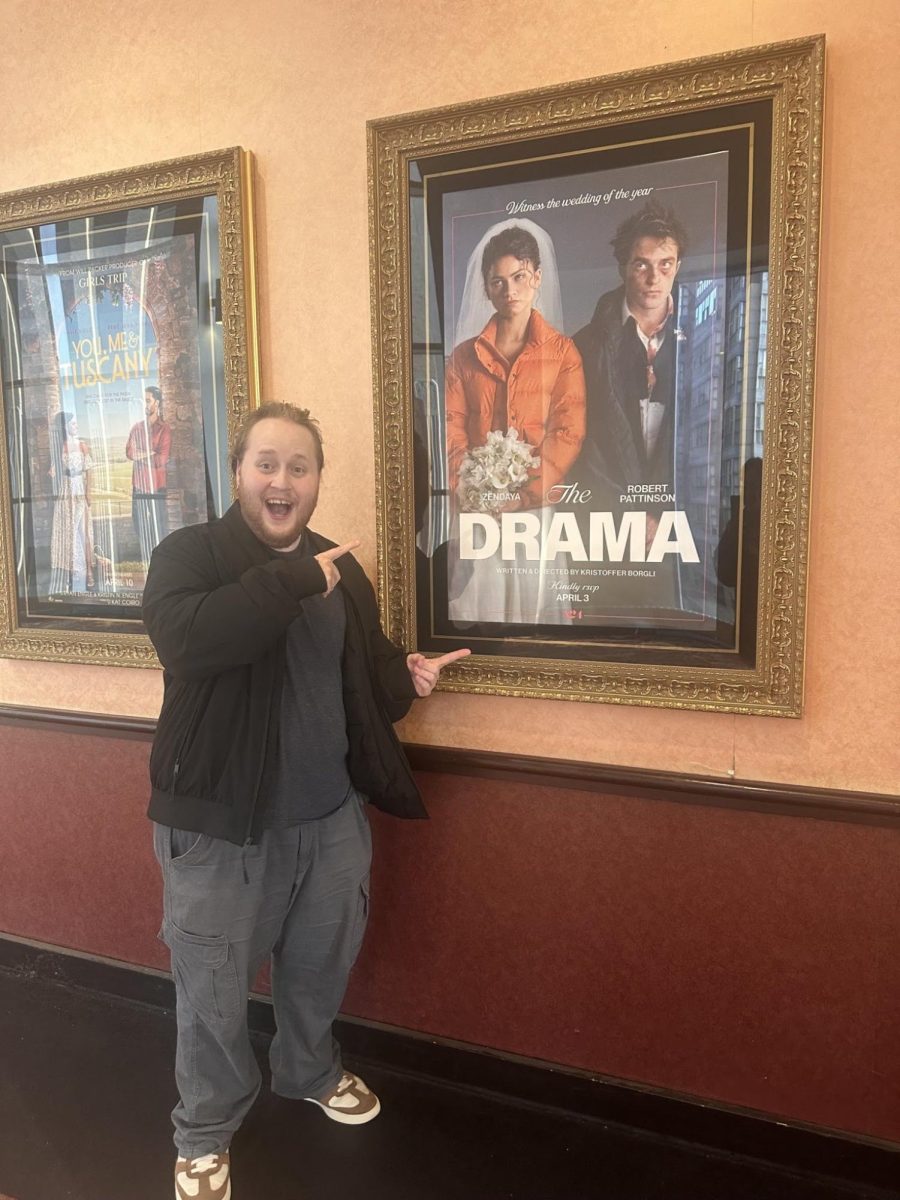
Kristoffer Borgli’s latest film, “The Drama,” follows the harrowing limitations of “unconditional love” and the selectivity of the benefit of the doubt through the premarital jitters of Emma Harwood and Charlie Thompson.
Emma, played by Zendaya, and Charlie, played by Robert Pattinson, are a soon-to-be married couple living in Boston as a publisher and a museum curator. They met in a coffee shop while Emma was reading, and their love story feels like any other sickeningly sweet meet-cute in a romantic comedy. The audience is awarded a quick synopsis of the start of their love story, the pair writing their wedding vows and taking the audience on a swift journey of their first meeting and date.
About twenty minutes into the film, during an intimate wine tasting dinner with maid of honor Rachel (Alana Haim) and best man Mike (Mamoudou Athie), Rachel insists that the group expose the worst thing they’ve ever done, turning the film on its head. From this point forward, spoilers to the film will be included for analysis purposes.
Rachel threatens to tell her husband Mike’s story, coaxing it out of him. He reluctantly reveals that he once used his ex-girlfriend as a human shield during a dog attack. Charlie admits that he cyberbullied a peer so badly the peer’s family had to move, and Rachel says, through a Cheshire grin, that she locked a disabled boy in a closet in the woods and left him there for dead, pretending she didn’t know where he was when his family sent a search party for him. To her luck, he survived.
When it comes to Emma’s turn, the movie’s plotline is finally ingrained. She shamefully shares that she planned a mass shooting at her high school as a teenager. She had a manifesto recorded and brought her father’s rifle to school, the only thing stopping her being a news release of a shooting at their local mall that same day. She shares that she was in a depressive state, and even reveals that she is deaf in one ear, not because she was born that way, but because she held the rifle too close to her ear while practicing her shooting in the woods.
Rachel is immediately horrified, reminding the group that her cousin lost her ability to walk in a school shooting. She is repulsed by Emma’s confession, shaming her and setting up the important, underlying thematic story that Borgli aims to uncover.
Haim gives a noteworthy, perfect villain-esc performance in the film, from microfacial expressions to condescending vocal inflections. Rachel’s character is a wealthy white woman whose identity is rooted in a sense of political correctness, while refusing to look inward. She claims victimhood under the guise of social justice, her projection of her guilt falling onto Emma’s past plan. Her immediate disgust of Emma’s incompleted mass shooting plan reveals one of Borgli’s takeaways: That there lies a hypocrisy in the group’s outlook on Emma.
All three of them went through with their “worst endeavor”: Using someone as a human shield, bullying someone so bad they had to move and leaving a disabled person for dead in a locked closet. The difference Borgli intends to implement? That Emma did not, yet is ostracized to an almost irreversible degree. Her friends would have characterized her as one of the kindest and most empathetic people they knew, just mere minutes before the confession. Emma even empathizes with the wedding DJ, while the rest of the group votes to fire her because of one offense that they would have never known if they had not investigated.
Borgli juggles multiple commentaries throughout his plot. The marketing of the movie indicates to viewers that it is a rom-com-esc movie with a twist, but the heaviness and triggering nature of Emma’s confession is not carefully tended to, therefore leading to a shocked response from viewers. Audiences argue that A24 films are suggestive in themselves that they will challenge social norms, but Borgli missed the mark on the film’s marketing and viewer advisory.
Though the topic of mass shootings is sensitive and has created division in the United States’ political climate, the film is important in stripping back the stigma surrounding mental health, the access that children have to unrestricted internet and the significance of microaggressions, all while discussing the limitations of unconditional love.
It is apparent from the beginning of the film that Rachel has a distaste for Emma, who is a bi-racial woman. The audience even sees Rachel tell Emma that she looks ugly when she cries and that she shouldn’t cry at her wedding. As a black woman, Emma is innately held to different standards due to harmful stereotypes of black women being aggressive.
Though Emma is never characterized as inexplicably aggressive before her confession, Rachel’s reaction to Emma’s confession throws away everything she knows of her character and becomes the fixation of her identity. Coincidentally, this did not happen for any of the other three confessions who actually harmed another person’s life. The intersectionality of Emma being a woman and black is apparent here, as she is a target for the group to project upon.
Borgli’s attention to the flashbacks of Emma’s time in high school and during her planning plays an important role in creating empathy for Emma’s character. Emma grew up with a dad in the military, moving around often and not having close companionship. When she settled in the south and got to high school, she was bullied and left alone often. She claims she had an obsession for the internet’s “aesthetic” of mass shootings, posing with her father’s rifle and pretending to shoot people, mimicking the community she had found online that also shared her dark mindset. Borgli aims to bring attention to the nature of Emma’s situation: Young, depressed, unattended and in search of curing a lonesome existence.
Borgli poses multiple questions here. Is Emma redeemable for something she almost did as a teenager? Do we ever truly know the intricacies of a significant other that we meet in adulthood?
What Borgli does not outwardly suggest is the crux of the film’s purpose. Mike confessed that he used an ex-girlfriend as a human shield, which he continues to do throughout the film, allowing Rachel to attack Emma repeatedly and take no action or opinion of his own.
Charlie, who cyberbullied a peer so horribly he had to move, hides behind his “nice guy” persona while allowing Emma’s character and growth to be taken into question and cheating on her with a co-worker, all because he does not harbor the ability to confront his own emotions about Emma face-on; therefore, almost “cyber bullying” Emma by taking his thoughts anywhere but directly to her.
Rachel gives a snarky maid of honor speech, cuts Emma off and acts on impulse with no empathy, just as she did when she was annoyed and locked the disabled kid in a closet, never going back for him.
Misha, Charlie’s co-worker, says the worst thing she has ever done is cheat, which she repeats with Charlie. All of these characters are repeat offenders of the worst thing they’ve ever done, but not Emma. Yet, she is deemed dangerous because these characters cannot fathom growth and forgiveness from something they are ashamed of.
Zendaya and Pattinson give chilling performances, embodying the likes of Emma and Charlie and driving home the mystery that is unconditional love. Zendaya’s acting is arguably her best — raw, dynamic and a refreshing new character for her. Pattinson earnestly reveals his range with Charlie, being able to execute the complete opposite of Bruce Wayne on the big screen.
“The Drama” toggles with microaggressions, mental health awareness and our capacity for empathy, forgiveness and nuance. It is a jarring, but important film that, if anything else, will have an audience talking about whether it missed the mark or not. Though the content is heavy, it requires viewers to break into their own analysis and psyche and pick apart what they have seen inside the cinema, outside of the cinema.