

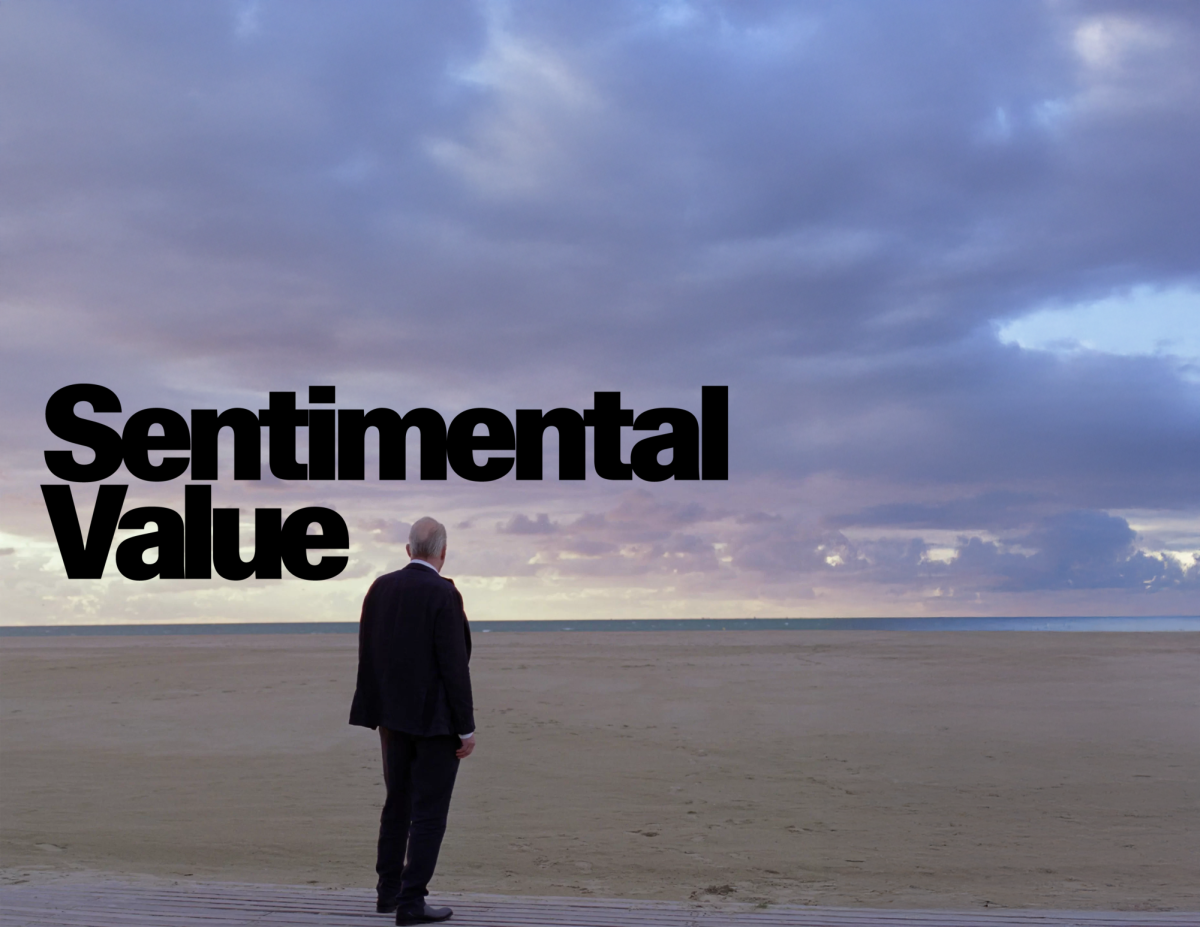
“The Worst Person In The World” director Joachim Trier makes his way back to the cinema with Renate Reinsve in “Sentimental Value,” a nine-time Oscar-nominated, flawless discovery of familial grief and unresolved resentment.
The primarily Norwegian film follows sisters Nora (Reinsve) and Agnes (Inga Ibsdotter Lilleaas) as they navigate their reconnection with their prideful, estranged father, Gustav (Stellan Skarsgård). Trier revolves around the tumultuous relationship between filmmaker Gustav and actress Nora, two artists unable to communicate in any language other than art.
Trier weaves themes of generational trauma, the depth of sisterhood and the power of language through intentional lighting and a deep, profound understanding of what it is to cast a near-perfect film. It is as if Reinsve and Lilleaas have genuinely lived this story. Their acting was raw, stripped back and incredibly vulnerable, a constant state of yearning for what could have been in their relationship with their father. Their depiction of sisterhood’s strength and importance holds a mirror to every woman who understands what it is to only have their sister in times of defeat.
Nora and Agnes, now in their 30s, reconnect with their father Gustav after the death of their mother. Gustav approaches Nora with a role he has written for her in his new film. When Nora turns it down in defiance, Gustav recruits an up-and-coming American actress, Rachel Kemp (Elle Fanning), to fill the role and garners funding regardless.
The plot intertwines numerous storylines, but heavily fixates on that of Nora and Gustav. Fanning plays her role perfectly: A genuine, eager and passionate American actress drawn to Gustav’s work after a screening at a film festival brings her to tears. Throughout the film, Rachel struggles to find her footing. She dyes her hair brunette, exercises a Norwegian accent — but nothing feels right. The part wasn’t made for her. It wasn’t made to be in English. The film inside the movie is personal, intentional and deep. It is for Gustav and Nora.
There are numerous instances of clash in Gustav and Rachel’s attempt to create the film, as such an unnatural pairing. Trier masterfully portrays both Fanning and Reinsve’s characters reciting the same monologue from Gustav’s script at different points in the movie. The contrast in the cadence and vulnerability is strikingly obvious. Reinsve wins every award in that scene alone.
Smaller subplots infiltrate the movie as well: Gustav’s grief over his mother’s suicide when he was a boy, Agnes’ discovery of the horrors and torture her grandmother endured through her retaliation efforts in World War II. The film is a commentary on the trickle-down of trauma: No one is exempt from the horrors of their lineage. Everyone is a product of suffering, pain and triumph.
The family’s childhood home is almost a character in itself as well. At the beginning of the film, a light narration begins as if plucked from the pages of a novel. It sets the film to play like a Broadway play, uncut, raw and intimate. Before any dialogue begins, we know that our leading characters are products of this broken home; divorce, suicide, death.
A summary of Nora’s sixth-grade essay begins, where she was tasked with writing as if she were an object; her house. A young Nora personifies the home, describing how its belly shook as she and her sister clamped down the stairs, how it watched them sneak out the fence to school, how it raised them. She wonders if the walls are ticklish, if the house ever felt pain. The house is established as a symbol of the body keeping the score; trauma and grief haunt her home, just as they do Nora and her family.
Trier also weaves in the importance of language throughout the film, whether it be mere vernacular or another medium, such as art. When trying to make the film work with Rachel, the bones of the film are brittle when translated into English. The inflections, the tone, the cadence. All wrong. It is meant to be in Norwegian; it is meant to be in Nora’s voice. It is real, true, communicative art. The film not only urges the importance of different language nuances, but the power that art holds to communicate sorrow, regret and deep unrest in a way words sometimes fail to.
When accepting his Golden Globe in 2020 for “Parasite,” Director Bong Joon Ho said, “Once you overcome the one-inch tall barrier of subtitles, you will be introduced to so many more amazing films.” Trier’s 2025 film “Sentimental Value” is a flawless emblem of this notion.
Trier’s unwillingness to cater to a certain audience or demographic through Americanizing the film is what gives it such a true, standalone quality. Once viewers forget themselves and accept the privilege that is subtitles, “Sentimental Value” will surely be recognized as Trier’s rawest, most aesthetically and emotionally complex film to date.







Deborah Mollomo • Feb 12, 2026 at 8:02 pm
Amazing review. So proud of you!
Peter • Feb 11, 2026 at 1:12 pm
Amazing review of a beautiful movie