What does someone do when they are faced with being put on sabbatical following a public mental breakdown at work? Well, for Jane the answer is simple; attend the company-mandated therapy session in order to get a licensed professional to sign off on her return to work. Except here’s the problem: she’s brought a gun to the therapy session.
Speakeasy Stage Company’s production of “Job” by Max Wolf Friedlich, follows a young woman, Jane, in her therapy session with her therapist Loyd. Directed by Marianna Bassham, the two-person, 80-minute, no intermission, play discusses the harsh reality of the world while stuck in the confines of what is supposed to be a simple mandated therapy session. There are discussions of feeling alone, Jane’s failed relationship, drug use and feeling like no one else can do the job she does. This play shows insight on how having a traumatizing job can make a lasting impact even if the person experiencing it does not notice..
“Job” opens with an abrupt start. Jane and Loyd are in the beginning of their session, but Jane holds a gun to Loyd’s head. Jane, clearly overwhelmed, stands there shaking as she tries to calm herself down. Then the lights flick down abruptly. When the lights come up again, Jane is still holding the gun but Loyd is now smiling. He says, “You are out of your mind. The answer is no – you failed, you’re useless. Now go back to your pathetic disgusting little bedroom,” before the lights go down again. When they turn back on, Loyd is attempting to defuse the situation by sharing how he is going to help her.
He offers Jane water, stating that he would go out into the hallway to retrieve it. Jane, in her crazed frenzy, blocks the door refusing to let him leave. She asks him if she’s legally obligated to call the police following her incident, to which he goes onto an explanation about a man who killed his girlfriend after expressing it to his therapist. He shares that the California Supreme Court decided that it was that man’s therapist was at fault because he had previously expressed the want. Loyd asks Jane if she intends to hurt people or herself with her gun to which she says no, and finally puts the gun away in her tote bag.
At this point, Jane remains close to the door, as though she is not only guarding the door so Loyd can not leave but also so she can run out of the door, highlighting her paranoia. Loyd however is comfortable in the room despite having a gun held to his head, indirectly showcasing his power in the situation.
Loyd asks Jane about her usage of humor in the situation, asking if she uses humor as a way to cope. Jane negates that, stating she uses Xanax and she does not need him to prescribe anxiety medication for her. When he questions her prescription, she shares that it is not a prescribed medication but instead she gets it from a guy in her neighborhood.
The rest of the play follows Jane exploring her mental health. From diving into her past with her family and failed relationship to the events surrounding her suspension. The play explores many mixed feelings surrounding Jane. Loyd tries his best, as a therapist, and as a person, to help Jane make sense of how she is feeling, but also tries to make sense of her himself.
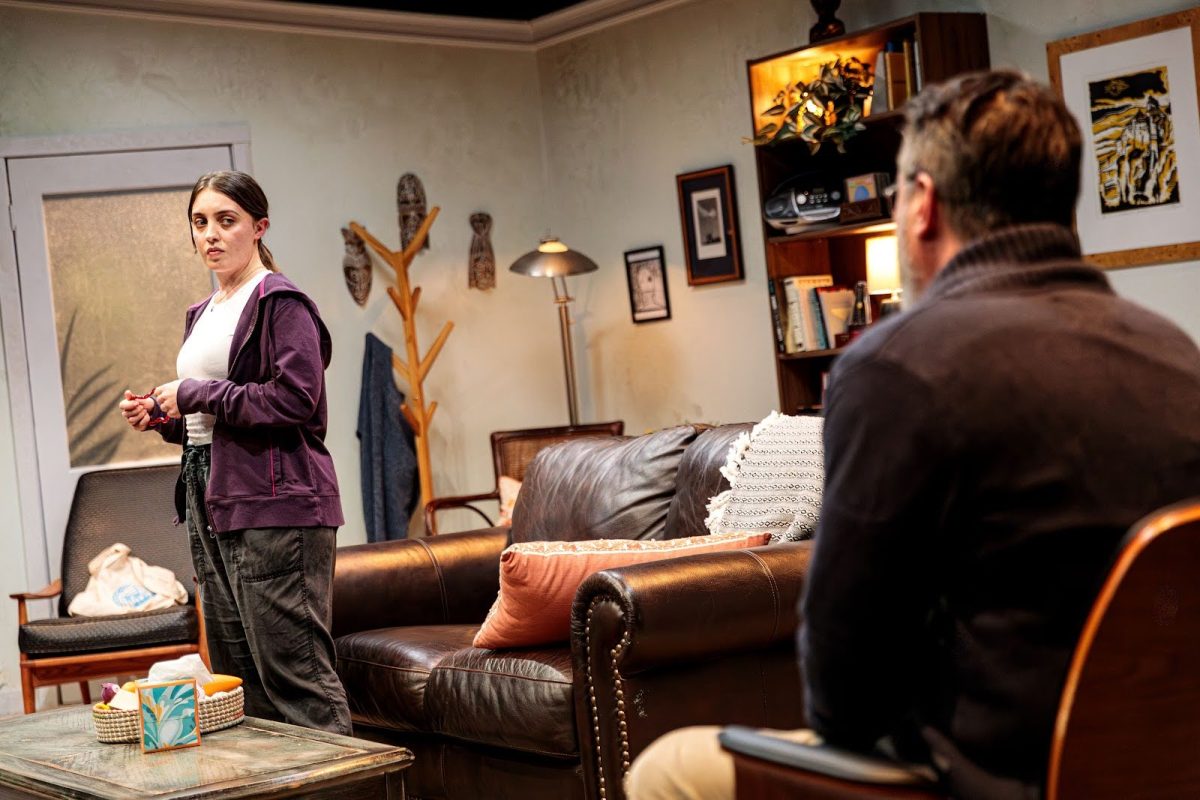
Jane is clearly in search of someone or something when she is in Loyd’s office. Part of her is arguing that he is a simple therapist, just trying to help her out by finishing her review. But the staging highlights the imbalance in power. Jane sits down for short periods of time, but there is consistently distance between her and Loyd. The only time they get close is when she begins to let her walls down before one of these paranoia episodes kick in, and she is back to being distant from him.
Lighting also plays a big impact in the storytelling as well. While there are plenty of lights in Loyd’s office, the comforting lights that they bring are drowned out by the fluorescent lights that take over the room. An indirect way of telling audiences that appearances are not everything, and that in a rather cliche way, looks can be deceiving. The only time that those lights consume the room is when Jane has the episodes, blacking out the room making it seem like there are so many things hiding in the shadows.
It only makes the audience wonder what exactly is the man sitting across from Jane hiding. Why did she pull the gun on him when she first walked in? Why did Loyd tell her she failed in that very first black out? Why was it that every time he told her some part of his life did she have these episodes? What kind of person was Loyd really?
In the staging of the show to portray Jane’s panic attacks, it helps develop the story that there is something wrong with the man sitting across from her. It is done so cleverly that it can be brushed over until the final events of the show. The audience believes that these episodes are stemming from the trauma of Jane’s job, and who she is as a person. Only in the end of this psychological thriller, it becomes apparent what is exactly happening. The truth is: Loyd was putting on a facade to build her trust, so he can have leverage over her.
Costuming influences the show in an interesting way. Jane is dressed in activewear, comfortable but signifying how she is ready to run away at any time. She carries a tote bag with a gun, building on her paranoia. She lives in constant fear of the world around her that she feels the need to carry a way of deadly protection on her at all times whilst wearing clothes that can let her flee in a hurry. Loyd wears stereotypical therapist clothes, like khakis, a dress shirt and a cardigan. Characterizing Loyd has someone who is down to earth and calming, but unlike Jane, he never removes a layer. He hides under his clothing, a way of showing that he’s not being truthful to the woman across from him. Jane, in contrast, removes her sweatshirt, signifying how she’s beginning to let her walls down around him and being open about who she is.
Friedlich’s “Job” discusses a lot of harsh topics. But at its heart it emphasizes that when someone in power is backed into a corner, they will pull every string to get ahead. For Jane, it is her desire and need to keep her job.
Josephine Moshiri Elwood puts on a fantastic performance playing paranoid, determined and scared Jane. Dennis Trainor Jr. portrays Loyd as everything he’s supposed to be, until his facade falters—but even then it does not. Bassham and the production crew make a wonderful performance out of a show that some audiences and critics say address too much in too little of a time. But that is the beauty of the show. It showcases how many different topics come up in a therapy session when the world is a harsh place, only growing increasingly hurtful. It demonstrates how one person can feel the weight of the world on their shoulders and be determined to protect the rest of the world from what they have seen.
Speakeasy Stage’s production of “Job” will run until Feb. 7 at the Stanford Calderwood Pavilion at Boston Center for the Arts. Tickets start at $25 with discounts for students, seniors, veterans and people 35 or under.