In a Malden home, twin sisters Maria and Lisa Ricci plan their meals down to the last dollar, stretching groceries, skipping certain foods and worrying about what they have will last through the week. Despite receiving SNAP benefits and relying on a local pantry, the sisters say rising food prices and limited income have made it increasingly difficult to afford even basic necessities, a reality becoming more common across Massachusetts.
Across the state, hunger is rising as food costs, housing and stagnant wages strain low- and middle-income households. Data from the Greater Boston Food Bank and Project Bread show continued reliance on SNAP and growing demand at food pantries, raising questions about whether families have meaningful access to affordable, nutritious food in one of the nation’s wealthiest states.
In their home, the Ricci sisters carefully stretch what they have.
A nearly empty refrigerator hums in the background at the Ricci household, its shelves holding only a few daily essentials such as eggs, a carton of milk and leftovers carefully saved for later in the week. On the counter, grocery receipts are stacked and studied, each one a reminder of how quickly grocery costs add up.
“We almost make it to the end of the month, but sometimes we don’t, as we have to eliminate some foods we like just to save money,” said Maria Ricci.
For the sisters, both senior citizens living on limited incomes, food insecurity is not a temporary hardship. It is a constant calculation shaped by rising prices, fixed benefits and difficult trade-offs.
“We are always worried about what we are going to do next,” said Maria Ricci.
A life shaped by instability and rising costs
The Ricci sisters have lived in their family home in Malden since 2018, after years of housing instability.
“Prior to living here, we were bouncing around to different homes such as in Florida, Somerville, Nahant, East Boston and now Malden due to unaffordability,” said Maria Ricci.
The home, left to them by their oldest aunt, came without financial support. Since taking over the payments in 2018, the sisters said their financial strain has only grown, particularly when it comes to food.
“We first began struggling with groceries in 2018,” said Maria Ricci.
That struggle has only intensified.
“This is the worst now,” said Lisa Ricci.
Lisa, who has been disabled since 2006 and is partially blind, receives about $950 per month through Supplemental Security Income. She also manages diabetes, which requires a strict diet that has become increasingly difficult to maintain.
“If you want to eat healthy, it is expensive,” said Lisa Ricci.
Her sister Maria, who previously worked as a substitute teacher, lost her income in December after undergoing major thyroid surgery.
“Getting laid off without pay as a substitute teacher and bouncing to different schools has really affected me a lot,” said Maria Ricci.
When Food Comes First and Everything Else Waits
Both sisters receive about $298 per month in SNAP benefits. But they say it doesn’t go far enough.
“We just look for the best price, the brand does not matter to us,” said Lisa Ricci.
They shop carefully, searching for deals and dividing food to last through the month.
A typical trip to the store is not routine, but calculated. The sisters compare prices aisle by aisle, often putting items back before reaching the register. Without consistent transportation, even getting to the store can mean budgeting for a ride, adding another layer of cost to an already tight equation.
“Some healthy foods I had to cut out and stop buying to eat, such as fish, due to how pricey and expensive products are,” said Lisa Ricci.
For Lisa, those sacrifices directly affect her health.
“Food is everything for us especially, it’s our fuel for our everyday lives,” said Lisa Ricci .
Even accessing groceries comes at a cost.
“We also have to take Uber to go get food at times, which is another whole other expense,” said Maria Ricci.
At times, the sisters say they delay paying bills just to afford food.
“To have enough money is the big worry to afford a roof over our head and food on our table,” said Maria Ricci.
A Statewide Pattern
Their experience reflects a broader trend across Massachusetts.
According to the Greater Boston Food Bank, food pantry use remains about 70% higher than before 2020.
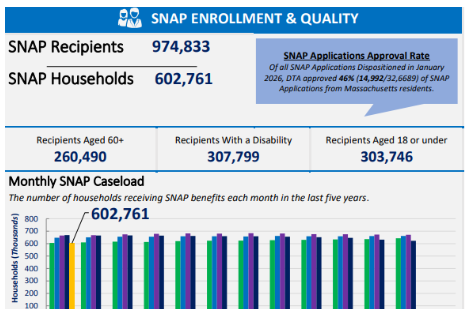
At the same time, data from the Massachusetts Department of Transitional Assistance shows SNAP serves roughly 1 in 7 residents statewide, with an average benefit of about $323 per month, or roughly $11 per day. For families like the Riccis, that $11 is not enough.
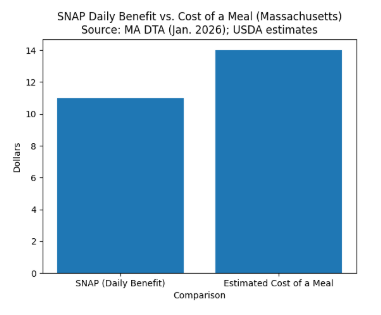
For families like the Riccis, that amount does not fully cover the cost of food.
“You have to plan and make sure you have enough food for weeks,” said Lisa Ricci.
The data also shows that most SNAP recipients are either under 18 or over 65.
A Pantry on the Front Lines
At Bread of Life, a faith-based nonprofit in Malden helping ease food insecurity, demand remains high.
“We serve about 3,000 people per month across our programs,” said Gabriella Snyder Stelmack, executive director of Bread of Life.
The pantry serves communities across Malden and surrounding areas such as Everett, Revere and Chelsea, providing food through multiple programs.
“Food insecurity is a chronic issue,” said Stelmack. “It’s driven largely by long-term factors, especially the lack of affordable housing.”
Many residents are cost-burdened, spending more than 30% of their income on housing, leaving less for food and other essentials.
“When you combine that with rising food prices, energy costs and everyday expenses, people are often forced to choose between paying rent and buying food,” said Stelmack.
The pantry sees demand increase at the end of the month as SNAP benefits tend to run out for residents.
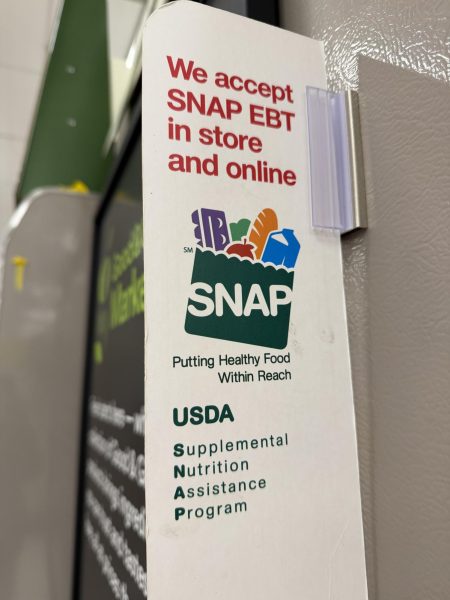
“SNAP was never intended to fully cover food needs, it’s supplemental,” said Stelmack. “It helps, but it’s not enough for most families.”
Hunger Is an Economic Issue
At Project Bread, researchers say hunger must be understood as an economic problem.
“Hunger is an economic issue, not simply a food supply issue,” said Laura Siller, senior director of research and evaluation.
Food banks operate within what is considered a secondary food system, distributing food through partner agencies but not addressing root causes.
Project Bread focuses instead on policy and systems, including SNAP enrollment, child nutrition and health care partnerships. The organization served nearly 17,000 clients through its hotline.
Why Hunger Is Rising
Despite Massachusetts’ wealth, the cost of living remains high.
“The cost of living is extraordinary,” said Siller.
Housing, food and health care costs continue to rise, while incomes do not always keep pace. In some communities, families need significantly more income than they earn to meet basic needs.
“The core issue is wages,” said Siller.
A Quiet Struggle
For the Ricci sisters, those challenges shape everyday life.
They continue to monitor prices, divide food and make careful decisions about what they can afford.
“We grew up with the wisdom of how to look for food, but all we can do is stay positive, and do our research,” said Maria Ricci.
At the end of each month, the routine repeats itself. The sisters take stock of what remains, adjusting meals, stretching portions and hoping what’s left will last just a few more days.
“You have to plan and make sure you have enough food,” said Lisa Ricci.
In a state known for its wealth, their experience reflects a quieter reality, one where hunger is not always visible, but deeply felt. And for families like the Riccis, it is a reality measured not in statistics, but in what is left on the shelf.
On some nights, that means choosing what not to eat but saving what’s left for tomorrow, just in case.