Suffolk University’s art and design program is offering a new course this upcoming fall, Design for Civic Engagement. The course is open to all students and will combine graphic design, political activism and Boston civic engagement. The course will only be available in the fall every two years to allow the local and national election cycles to lead the curriculum.
The course is being taught by graphic design and art instructor Kayla Schwartz. Last spring, Schwartz was awarded a faculty fellowship grant through the “Dr. Dulcinea de Correa Rodrigues and Dr. Rachael Cobb Civically Engaged Faculty Fellowship Program.” The grant asked a faculty member to write a new course or project around the idea of civic engagement.
This new course will run in alignment with the POLSH361, a course about voting rights and election law, taught by professor of political science Dr. Rachael Cobb. Schwartz said she and Cobb are working together to try to assimilate these courses during the upcoming fall semester. POLSH365 focuses more on the political and legal side, whereas Design for Civic Engagement focuses on the visual graphic design surrounding voting. She hopes that the students in both political science and graphic design courses can collaborate with these two classes, and hopefully take away something outside of their major.
“There’s a lot that could be learned on both sides of that equation,” said Schwartz.
Schwartz has already used current events and news to fuel her graphic design content and curriculum and this proposal was something she had been thinking on since the year prior.
Schwartz has had students use text from important government documents and amendments, like the Bill of Rights, for previous class projects. What she learned is that the content itself is hard to decipher and apply to our current society. This is a hard but interesting design challenge for students — to bring an obtuse piece of text and bring it into a visual space to understand why it matters.
“I find that civic engagement content is usually a nice kind of hotbed of creativity for content in terms of [making] provocative visuals. Using content that kind of speaks to that space is highly conducive,” said Schwartz.
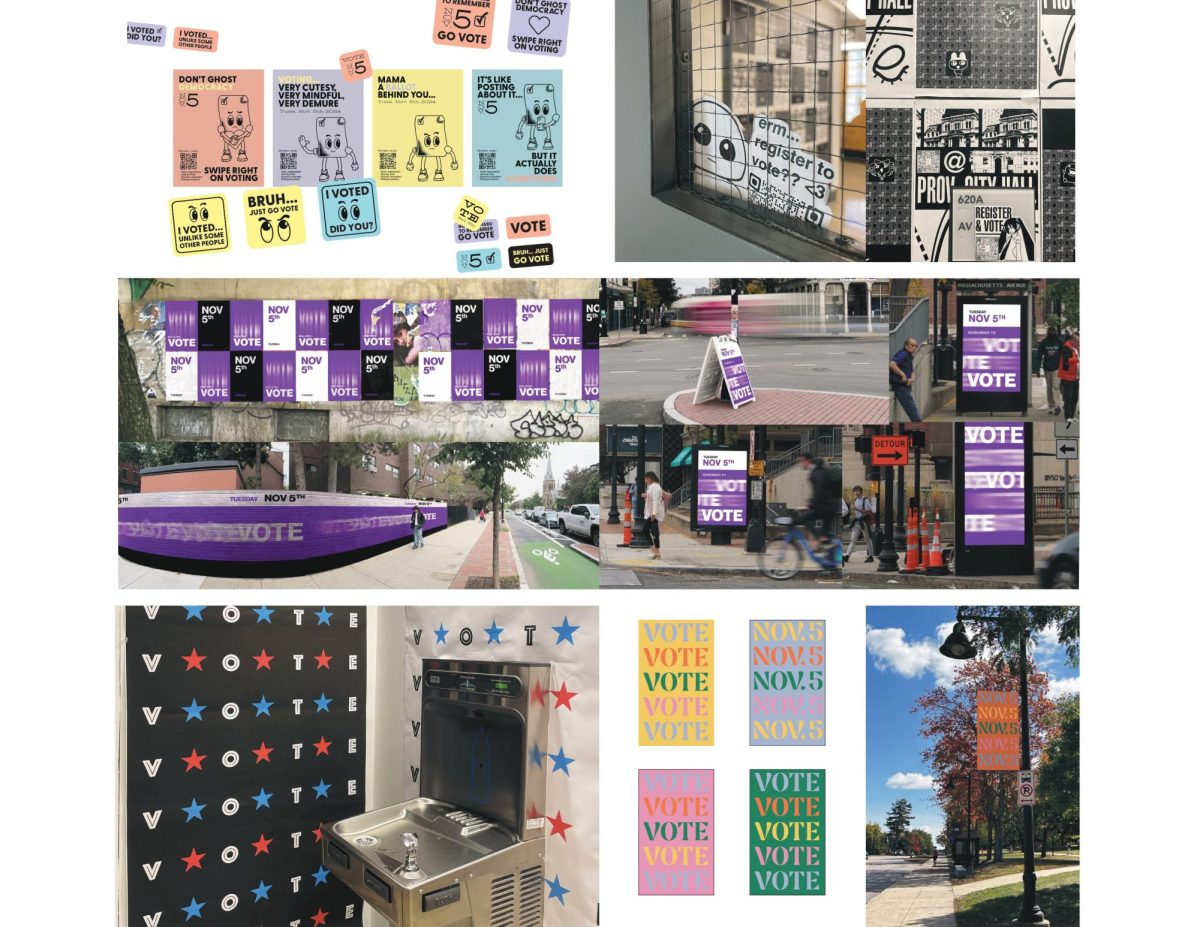
In the fall of 2024, Schwartz assigned her environmental design class to create designs to be posted in voting locations. This made students think critically about their target demographic of the varying voting locations and analyze which aspects of the election were the most important to the general population.
“That specific project gave birth to this class in terms of [how] that worked out so incredibly well to have a real election to design things for, and really put them in the communal space of our campus,” said Schwartz.
When President Donald Trump was elected for his second term as United States president in November 2024, Schwartz and her students returned to campus and were hit with a “cold reality.”
Most of them were disappointed with how the election went, but it also solidified Schwartz’s new civic engagement class idea. Politics are unpredictable, and that is what makes this new class so innovative. To meld the unpredictability of politics with meticulous and strategic graphic design.
“Elections have consequences … out of control-ness is a part of design,” said Schwartz.
Since Schwartz moved from Alabama to Boston, she has had to get used to the two differing political climates. Her passion for news and current events has driven her curriculum and way of teaching graphic design.
“It’s interesting to use content that can really swing one way or another, and to walk that fine line of being the middleman of visual communication and delivering content or information in a non-partisan capacity,” said Schwartz. “I intended for this to be highly partisan so that designers can learn that they have agency over that.”
History will be a substantial part of this course, specifically highlighting American artist Sister Corita Kent. She was a religious sister who taught at Immaculate Heart College in Los Angeles, California. After Kent worked mostly in screen printing, she became so passionate about civic engagement and religious devoutness. Kent paved the way for politically focused graphic design in the early 20th century.
Students will additionally study how graphic design was at the forefront in America post World War II and into the Vietnam War during the course.
Through this class, Schwartz wants students to remember the agency that graphic designers have. Art has immense power and offers artists the opportunity to create something profound. No one is a complete expert in anything, but if you put the right color or composition on a poster or billboard, you might just capture someone’s attention, Schwartz said.
“We can cut through the noise and make something memorable, something that fits,” said Schwartz.
Schwartz designed the class so that any student, no matter their major, can take this class if they are interested in the content. There are no prerequisites, and the course will include a printmaking workshop during the first few weeks to catch students up on the base layer of the course.
Some of the major projects include creating mock-up graphics to put on voting locations to increase voter turnout. Their second project will be to design a proposal based off of a project a local nonprofit or public initiative needs. There are still a few seats open for Design for Civic Engagement, and Schwartz is hoping for a full class.