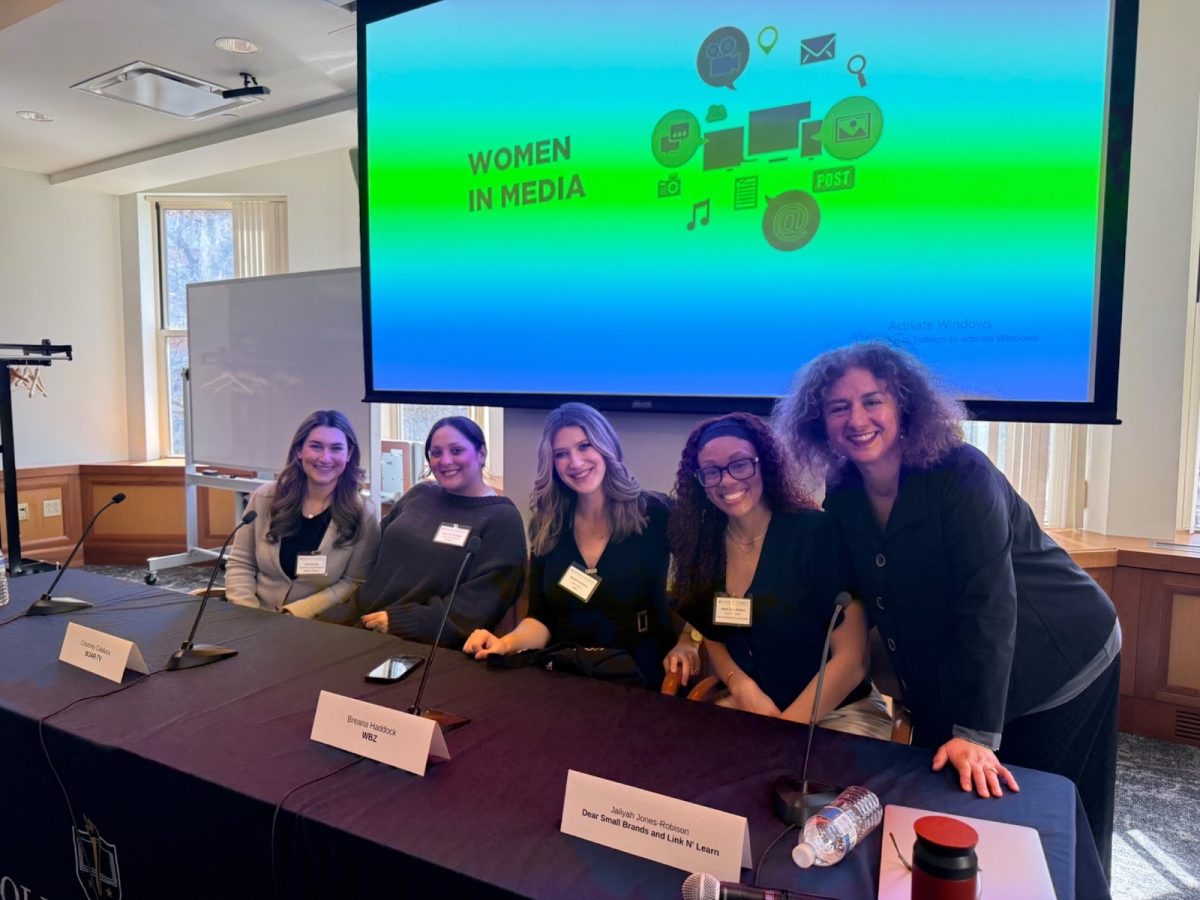
Suffolk Communications and Journalism Department hosted a panel of alumnae professionals in media and communication fields March 21 to discuss their journey post graduation and the trajectory of their careers.
The panel consisted of four women in different jobs, giving a large insight into the career paths available for CJN majors after graduation. This is the fourth year the department has hosted this event, which gained a large turnout, filling most of the seats in the Sawyer Library Poetry Center.
This year’s panelists were Breanna Haddock, anchor and reporter for WBZ-TV; Courtney Colaluca, senior news producer for WJAR-TV; Jaliyah Jones-Robison, CEO and founder for Dear Small Brands and Link N’Learn, and Julia Simone, multimedia journalist for CBS 13 News.
“I think the most important aspect is that undergrad students can see Suffolk alums, people who are once walking the same hallways as you, in positions that you eventually want to be in,” said Morgan Austin, the senior assistant director of journalism, media and communication career community.
Austin and Shoshana Madmoni-Gerber, associate professor and department chair of communication, journalism and media, organized the event.
The event consisted of two parts. The first was a series of prepared questions asked to the entire panel or individual members by Madmoni-Gerber, and the second was a chance for the students in the audience to pose their own questions to the panelists. As part of the introduction of the panelists, a sample of their work was also shown, that being a clip from a broadcast segment or, in Jones-Robison’s case, her website showcasing the brands she works with.
“My biggest takeaway was probably the insight that the panelists were able to give us, especially being a younger student, it was really good to kind of understand their paths more,” said Gina Anton, a freshman journalism major and attendee of the event.
For each of the women, a common theme they touched upon during the panel was being persistent through the initial rejection of the industry.
“I was working on putting together a better [news] reel, building on my reel of what I had. I sent that out to I don’t even know how many TV stations and I got a lot more no’s than I got yes’s too. I got two yes’s out of everywhere that I sent a reel,” Haddock said during the panel.
For Simone, the difficulty she faced in finding a job post graduation meant that she had to employ more involved tactics to make herself known to employers and recruiters.
“I constantly was reaching out to people, whether it’s LinkedIn [or] social media, and that really helped me. Just putting a face to the name, trying to get people on the phone, that helps me too,” said Simone. “It sets you apart, it allows you to talk to someone and it’s not over email. It’s just a different connection.”
Beyond just persevering through disappointment, the panelists gave advice on other aspects of the industry as well, most specifically, about the presence of gender discrimination that remains within the field.
Colaluca touched upon how she has seen different treatment between when she takes on a leadership role in the newsroom and when that role is taken on by a male colleague.
“Because when Steve said the same thing, the same tone, and it’s different and sometimes I feel like I’m getting a little stigma attached,” said Colaluca. When referring to women being assertive in a newsroom, “I say own it, own it, own it, own it all day.”
This different treatment between men and women in the newsroom is not isolated to the social dynamics of the space, but also to the pay.
“You could anchor next to someone and have the same amount of years of experience as them and still not be paid the same,” Haddock said.
Despite the rejection and discrimination within the industry, the women all described similar sentiments about their feelings toward their jobs as a whole.
“I think the powerful part is people realizing, ‘Wow, I actually can do this. People actually want to read my newsletter. People actually want the services that I provide,’” Jones-Robison said.
For the other three panelists working in broadcast journalism, what made the job so fulfilling was the way in which the effect could be felt in the community.
“You really get to see the impact of how far what you’re doing, what your words are, and what visuals you’re putting out there are going and it’s so rewarding,” Colaluca said.
The event shed important light on the various aspects of the communications and media industry from a professional point of view, encouraging students to think about their futures in this field and putting into perspective both the pathways that exist as well as the challenges that persist.