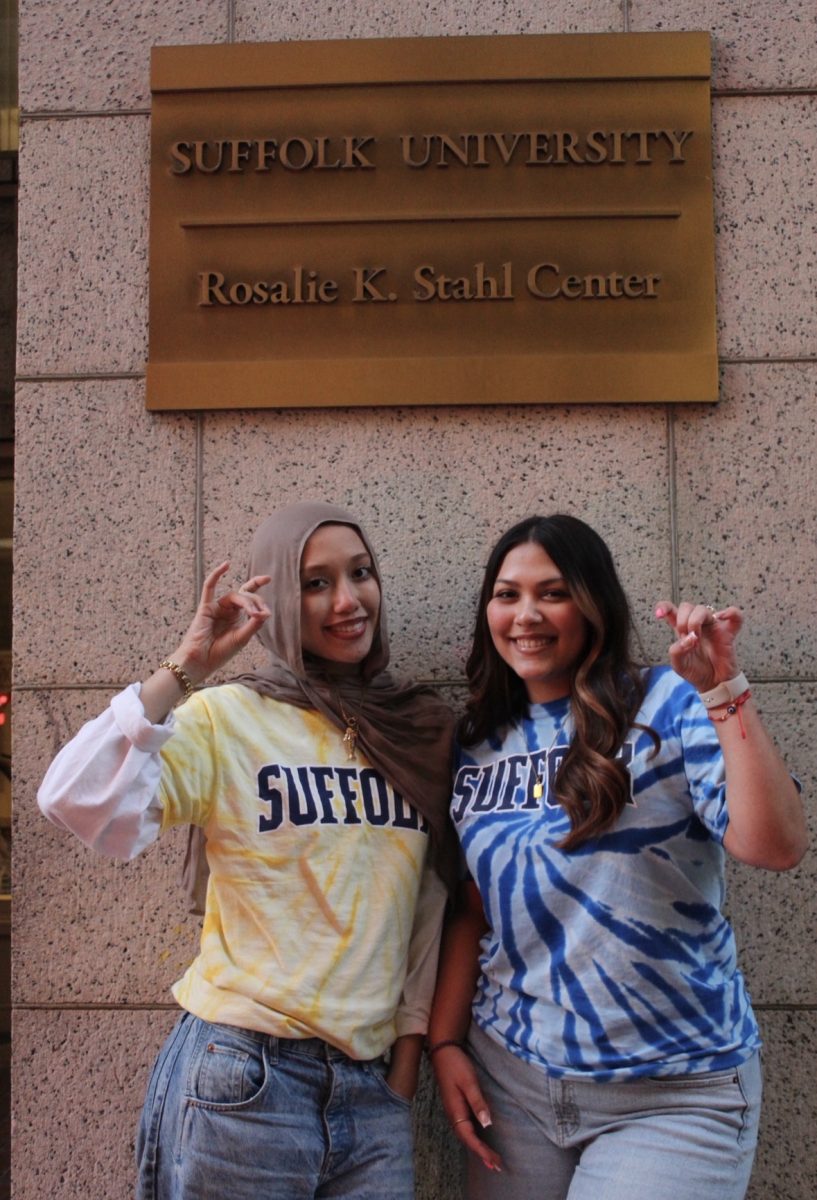
As application deadlines approach for orientation’s spring community support jobs, orientation team leaders, Kaylee Sanchez and Mona Ammar, are advocating for the roles they have gotten to play in the orientation and new student programming world.
Sanchez, a sophomore political science major originally from Taunton, Massachusetts, is a part of organizations across campus. From being an orientation leader and a senator in the Student Government Association to being treasurer of the Feminist Generation club, Sanchez has brought a diverse perspective into her new position as OTL.
“[OL] helped me meet so many people that I wouldn’t have even thought about talking to before and I feel like with all the training and everything I just know so much about Suffolk now,” said Sanchez. “I feel like I’m like an encyclopedia of all the departments and services and it benefits me obviously, I know where to go if I have a problem, but it helps me help my friends and orientees and things like that too.”
Ammar, a sophomore business analytics major from Braintree, Massachusetts, was also an orientation leader as well as a public relations chair in SGA. She also serves on the e-board for the Information Systems and Business Analytics club. Ammar also expressed the family-like bond that has come out of her orientation job experience
“Finding community with my peers, my orientation leaders and with Kaylee as well. Getting to know people from different schools and different years, like I know a bunch of seniors now, upperclassmen, people in the CAS school that I probably wouldn’t have ever met,” said Ammar. “I think it’s definitely broadened my social circle a little bit and it’s definitely a privilege to be able to know so many people and to learn about their experiences.”
A shared feeling between the two is how rewarding being an OL has been, for them and their students.
“I always empathise with my students when coming to another college to Suffolk or coming from high school to Suffolk, it can be a lot. So I’m always empathetic with them, of their journey and understanding where they are,” said Ammar. “So it kind of helps me become a better leader if I understand who I’m leading and their experiences, and it helps me better respond to how I can make their experience better.”
Orientation leaders complete a long training process, learning about the school and all its resources in depth in May after the spring semester ends, before working multi-day orientation events throughout the summer months with all of the incoming students.
Similarly, RAM Supporters are also returning students who help the incoming class transition into the Suffolk community as smoothly as possible. With a week-long training before the Fall semester starts, learning mostly the same information, they check on their roster of students roughly once every three weeks and are a resource for support and advice. Each RAM Supporter has a unique commonality with their students that pairs them together.
“It’s nice to have a shared experience with someone and be able to use what you’ve known in your first year, your second year at Suffolk, and give it to someone who also needs help and was in the same boat as you,” said Ammar. “So I always say it’s like being like an older sibling.”
Applications for these two positions, as well as Performing Arts Office Specialist, Programming Specialist and Logistical Specialist, are open, with a closing deadline Feb. 18.
This role does not require a work study, but attending one of the information sessions is mandatory. Information sessions will take place Feb. 4 at 11 a.m. in the Sawyer Business School building’s fourth-floor Stahl room, as well as Feb. 5 at 10 a.m. in Sawyer room 927 for those interested in RAM Supporting and at noon in the fourth-floor Stahl room for every position. Further sessions will be posted on the SuffolkRammy instagram page.
“I think that working in the orientation office, even if it’s a RAM Supporter, OL, whatever position you have, is so beneficial and so emotionally rewarding just because of all of the connections you make,” said Sanchez. “It’s a great connection to have and usually when people start working in the orientation office, they kind of just grow and they usually never leave.”