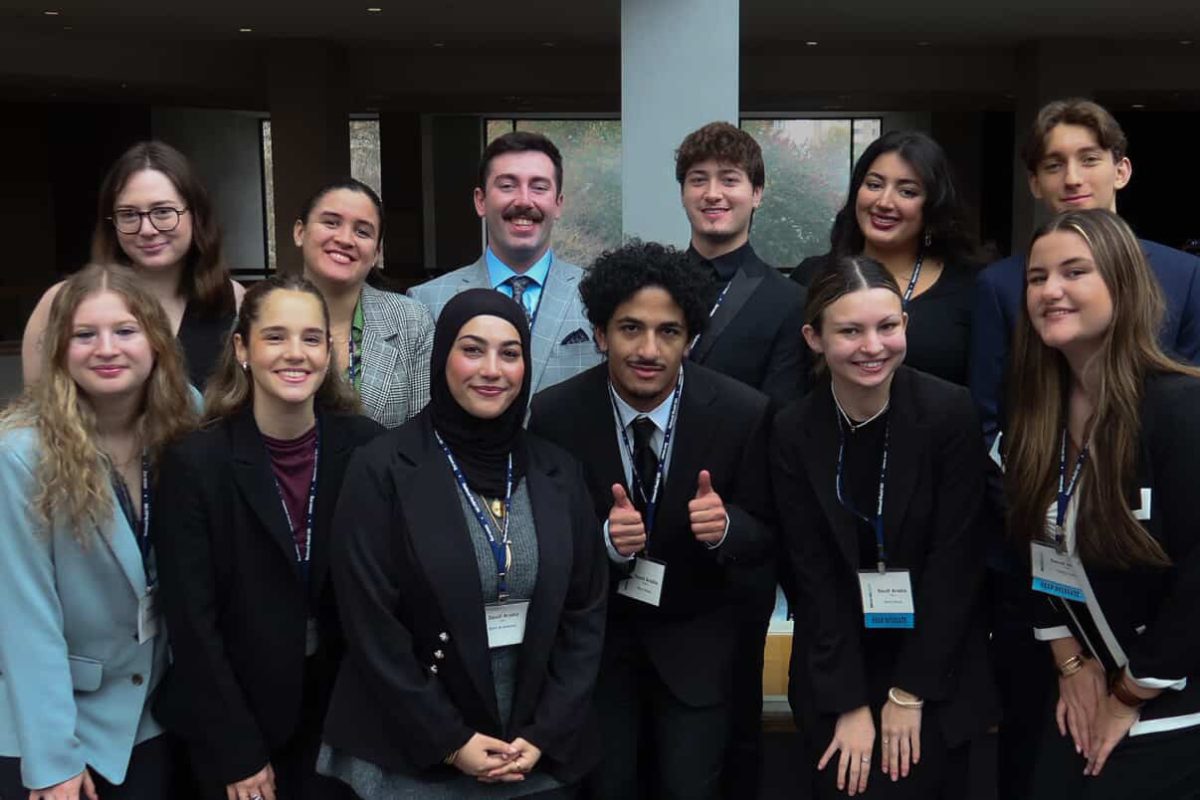
Students and staff gathered in the Stoll Room on the fourth floor of Sawyer Nov. 6 for the Careers in Nonprofit: Building a Career With Social Impact panel.
The event consisted of six panelists from a wide array of organizations across the state. Some of whom are Suffolk alumni, this included Kristiana Le, senior manager of community engagement at the Greater Boston Food Bank, Nora Mally, talent acquisition specialist at Planned Parenthood and Oliva Brooks, house manager and director of family-centered care at Ronald McDonald House.
Cohosted by the Center for Community Engagement, the Center for Career Equity, Development and Success, Suffolk ONE and the Communication, Media & Journalism department, the panel consisted of a discussion section followed by a networking section, allowing students a chance to make connections with industry professionals.
Moderator Dr. Trina Bryant, director of Suffolk’s Center for Community Engagement, opened the conversation by asking each panelist to describe a success story or moment during their time in the nonprofit sector.
Many of the panelists noted that seeing those they helped during times of need pay it forward by becoming volunteers themselves helped them actualize their impact.
Brooks recalled how her passion for nonprofit work began at Suffolk, during her time involved with a club that assisted hospitalized children with chronic illnesses. This helped her realize that “every day is a success story,” she said during the panel.
Dr. Bryant transitioned smoothly into perhaps the biggest question on attendees’ minds — what advice do the speakers have to say to someone aspiring to enter this line of work? Acknowledging potential financial struggles associated with taking up these kinds of careers, a few of the panelists urged listeners that if they bring in the passion, the hard work, that there is space for them in the sector.
Brooks described this career as “a ladder to climb.”
Mohamed Barrie, director of Teens in Print, went further with this, adding that nonprofit work starts “with a problem you want to solve,” and imparted the advice that there’s “always a new way to face old issues with new answers.”
Next, panelists were asked to address the elephant in the room — funding cuts.
Between the recent government shutdown affecting SNAP recipients and long-anticipated budget cuts to federal funding for nonprofits, the big question was how these struggles were affecting the organizations represented.
Mally acknowledged how the leadership at Planned Parenthood had anticipated and worried about upcoming funding restrictions. She acknowledged how this put a lot of pressure on the frontline staff who would have to relay the news of patrons’ healthcare as availability shifted from day to day.
“Be like water” and flow every day, said Mally.
Sal DiCristina, manager of food acquisition at the Greater Boston Food Bank, discussed the importance of diverse funding sources, from federal to state to private, and how those have each played a separate role during this difficult time.
Simone Lawrence, senior assistant director at BU PATH, encouraged students to discuss these issues with future employers as a hallmark of the strength of their leadership.
The next topic posed to the panel was about finding opportunities for portfolio and resume building. Panelists noted Suffolk’s rich alumni network and suggested exploring LinkedIn to find individuals in your desired career and reaching out, specifically to ask questions such as how they got to where they are.
Volunteering was agreed upon as the number one place to start at this stage in students’ careers, particularly due to the learning benefits and aid in discovering your own niche while having a low commitment.
When an audience member expressed concern over the necessity of students to be paid for their time, panelists described how this new generational push for pay has been considered by organizations and nonprofits and the panelists encouraged students to have these honest conversations with potential employers.
After the discussion concluded, the audience subsequently broke up to begin the networking section of the event. Panelists retreated to tables around the space and began to converse with students, with lively chatter filling up the room.
Anna Gonzalez, a junior psychology major, said the panel reaffirmed her desire to go into the nonprofit sector despite worries about financials.
Also present at the event were representatives from Nativity Preparatory School in Jamaica Plain, a tuition-free Jesuit middle school offering opportunities to young boys from underserved communities. Promoting their two-year teaching fellowship for recent college graduates, potential applicants learned about this opportunity to begin their experience with teaching early on and gain valuable professional development and mentorship skills.
Amaye Beebe, a freshman political science major, said that the panel gave her clarity regarding her dream to work in the nonprofit sector.
As the event came to a close, students felt a renewed sense of motivation on working towards their goals in nonprofit, despite the difficult times that may be ahead.