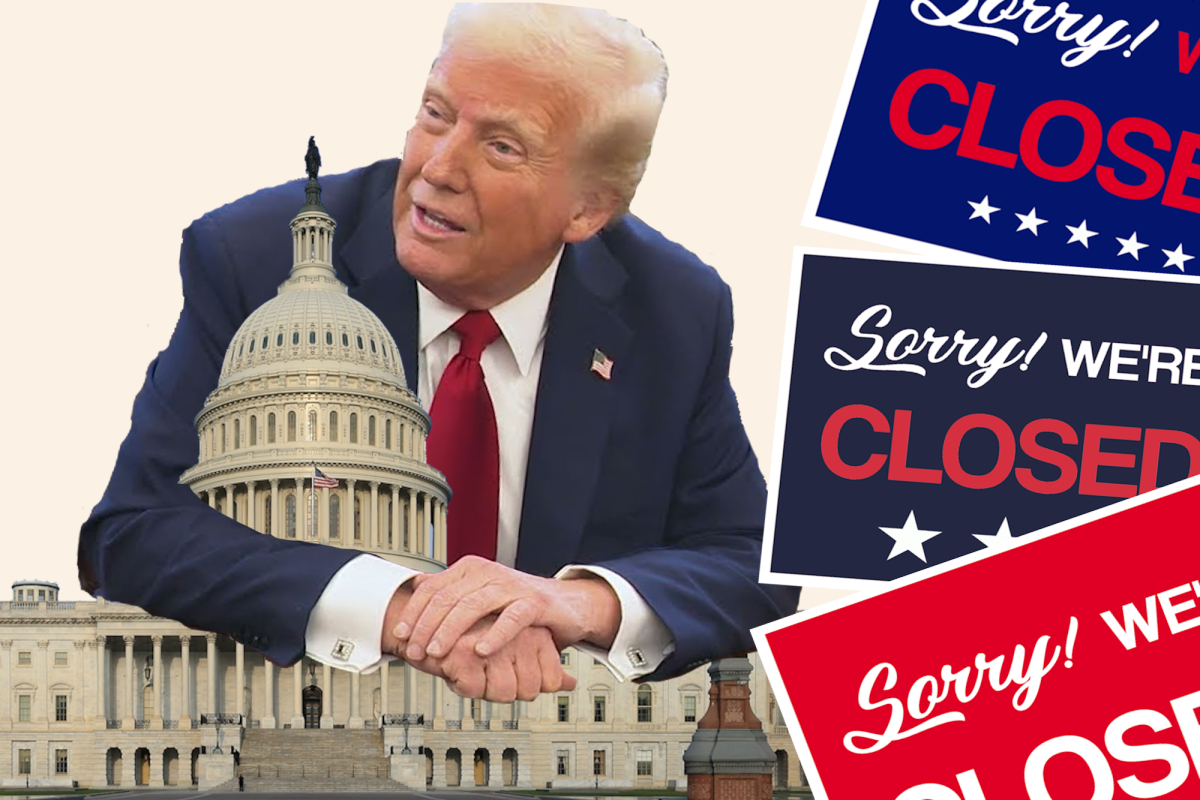
As this piece goes to press, the United States has entered the fifth week of its federal shutdown and shows no hope or sign of reopening any time soon.
As of Nov. 4, the 35th day of the shutdown, we are officially tied with the 2018-2019 record for the longest government shutdown in U.S. history.
The Senate has failed for the 14th time to reconsider the House’s funding bill. The Senate is scheduled to reconvene Nov. 4. A vote on the House’s funding bill is on the agenda, but with no active negotiations taking place, that vote is yet again — unsurprisingly and to no avail — expected to fail.
The House has been out of session since Sept. 19, with absolutely zero plans to return until the shutdown is over. They are only convening for pro forma sessions for the time being, which conduct “no legislative business, such as the introduction or debate on bills or resolutions.” In other words the House will do little to nothing to reopen this government. That’s a 46-day run of almost no chamber activity.
More than 100 bills have completed committee review and are waiting for House floor action, including 12 appropriations measures. Speaker Mike Johnson has continued the run of pro forma sessions, stating that the House will reconvene once the Senate finishes work on the shutdown legislation.
However, recently, Majority Leader John Thune says he is “optimistic” the Senate will move to end the shutdown this week. The Senate is likely to extend the deadline of the House-approved funding measure, which is set to expire Nov. 21, for several additional weeks. Thune told POLITICO that the deadline should be pushed to at least Jan., although he hasn’t committed to a precise schedule. Republican leaders are contemplating a new deadline that would range from late Jan. to March.
To put the shutdown’s impact into perspective, let’s examine the list of lasting consequences that have been imposed on my fellow Americans and me, shall we?
An estimated 1.3 million federal workers have been furloughed, going without pay and possibly never getting paid, according to President Donald Trump.
Information on the flu, COVID-19 and Respiratory Syncytial Virus is not being updated. There are many blind spots for local government and health systems.
Approximately 42 million Americans will not receive Supplemental Nutrition Assistance Program (SNAP) benefits.
A federal judge in San Francisco, California, had to issue a temporary order blocking the White House from firing over 4,100 employees.
White House Director of the Office of Management and Budget, Russel Vought, has said more than 10,000 layoffs are possible if the shutdown continues.
Vought noted that with the shutdown, the National Nuclear Security Administration has furloughed about 80% of its workforce, halting work in support, research, modernization and non-proliferation programs.
The Supreme Court has run out of funding since Oct. 18, 2025 and will be closed to the public.
The White House has frozen about $11 billion in U.S. Army Corps of engineers infrastructure projects.
Reports by the Department of the Treasury have estimated that the shutdown is costing the U.S. economy $15 billion per week.
Arizona Democrat special election winner Adelita Grijalva has yet to be sworn in by Congress.
Airports nationwide face flight delays due to air traffic controller shortages.
Social Security Administration services could be disrupted due to a potential halt in federal activities, according to experts.
Of the 1.3 million furloughed, yours truly has been furloughed and placed on forced leave from my position as a congressional intern in the Salem district office of U.S. Rep. Seth Moulton, D-M.A.
As per Trump’s White House memorandum, noting that furloughed workers might not get back pay, I face several uncertainties about whether I’ll even receive my internship’s payment. What am I supposed to do about the money I was going to use on my tuition? What am I supposed to do about my textbooks? What am I supposed to do about transportation expenses? What am I supposed to do about the everyday groceries I buy?
Admittedly, a mere part-time fall internship is by no means entirely sufficient for the aforementioned, but in today’s world, every dollar matters, especially as a student. Yet, I can’t help but have this question gnaw away at me every passing day of the shutdown: Why must the opportunity meant to help me grow professionally only leave me financially stranded and unemployed?
I cannot even begin to imagine the sheer scale of how much worse the financial situations are for those who are actual full-time federal government workers, whose paychecks support their families, cover their bills, rent, gas and food. Many of whom are the backbone of our nation’s institutions, including TSA agents, national park rangers, USPS employees, clerks, janitors, congressional staffers and case workers, working with no pay just to keep our nation up and running.
As if shards of glass pressed against my temples, I get a stabbing headache whenever I try to fathom how a country that prides itself on democracy — to the point it was enough for my parents to flee their homeland in pursuit of it — could so easily turn its back on the very people who sustain it.
Our federal employees are not just some bureaucrats; we are Americans, parents, veterans, neighbors and taxpayers, who became public servants for the greater good. Yet, when Congress fails to act, we are the first casualties of a dysfunctional, polarized and politically mismanaged system.
We are but mere gambits being sacrificed before our king.
What is appalling to me, however, is that these shutdowns are just being used as a political strategy. We saw the same playbook play out during the 2018-2019 shutdown under the Trump administration, when partisan gridlock over immigration and border wall funding.
With yet another Trump shutdown, young people like me who are students simply aspiring to serve, interns hoping to learn to be future public servants, are disheartened. We bear witness to the fact that even good work in government can be undermined by bad politics.
We deserve better than this cycle of recklessness by our very own leaders. Until our leaders in Washington, D.C. remember that our federal workforce, the millions of Americans that rely on its services, and governance overall is a responsibility and not some petty partisan competition, only then will the real cost of this shutdown be measured, not in lost dollars, but in lost trust by we the people.