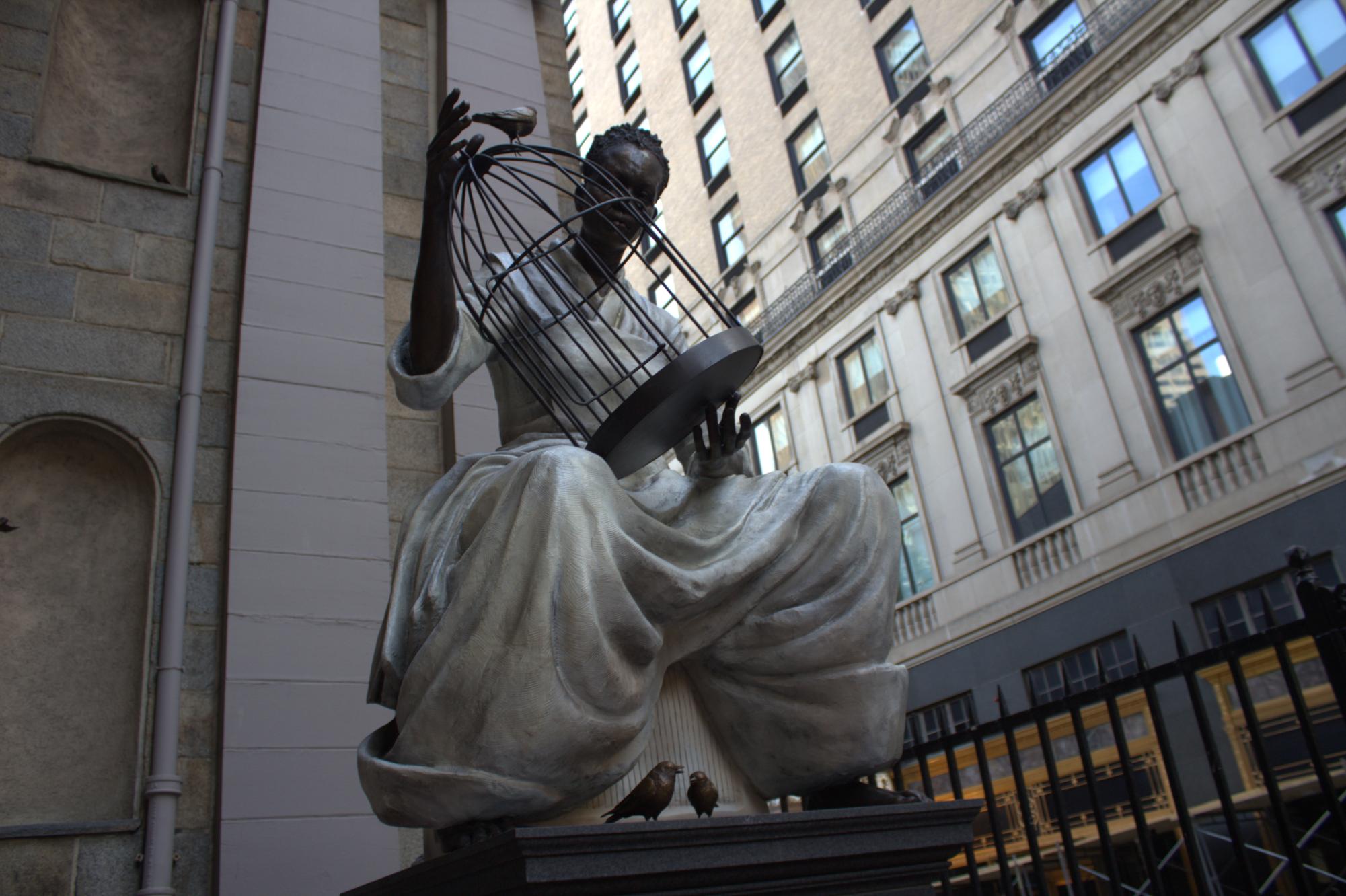
King’s Chapel on Tremont Street unveiled a statue Sept. 14 that recognizes the 219 people enslaved by the past members of the church.
The statue is of a black woman releasing six birds from a cage, giving them freedom. This monument is directly en route to class for many Suffolk students, being an important landmark that students see daily. The memorial was created by the artist Harmonia Rosales and is a part of a larger project by the Chapel in their restorative justice work to support the community.
WGBH reported that this memorial is a striking addition to the Freedom Trail, in large part because it is the first monument to recognize Boston’s place in the history of slavery.
The Freedom Trail is where tourists come to see the history of Boston in America’s Revolution. However, what is associated with the Freedom Trail and other monuments across Boston are their representations of historical white men. A list of just a few of the men represented includes George Washington, Alexander Hamilton, George Robert White, Paul Revere and Benjamin Franklin. These men and others represented are integral to Boston’s history, but serve to show what aspects of Boston’s history are often promoted.
There has been an increase in diverse statues in the Boston area over the last few years, one notable example being “The Embrace” in the Boston Common that commemorates Martin Luther King Jr. and Coretta Scott King. However, this increase doesn’t account for Boston’s own culpability in slavery and the oppression that followed.
“We know now that at least 219 people were enslaved by ministers and members of this congregation in the seventeenth, eighteenth, and early nineteenth centuries,” King’s Chapel stated about the statue. “We know that our church, a national landmark, was built with wealth generated by enslaved human beings, and that while we honor an important abolitionist with a memorial in the church, there are also monuments in our church that commemorate enslavers.”
This is an important move in the right direction to remember the fact that Boston was a city that facilitated the slave trade. It’s all too easy to forget that northern cities, such as Boston, were often integral parts of the trafficking of human beings.
This topic has been a subject of discussion among students, many of whom have studied and analyzed the history of enslavement and the process of reparations and representation, which this statue is involved in.
A Suffolk senior English major, Jane Blair, said, “This statue tells a story that has largely gone ignored for centuries. A lot of people still minimize the role that enslaved people played in making the United States what it is today, especially in the North.”
Blair said that it is important to highlight both the positive and negative sides of the Chapel’s history in order to fully understand the history of the United States.
“Glorifying historical figures and failing to acknowledge the people they oppressed can be a dangerous practice. I think this statue is a huge step in the right direction,” Blair said.
Abba Connally, a Suffolk senior English and History major, works as a library resident with a local historical archive, said that she appreciated the effort that the King’s Chapel put into denouncing and bringing attention to the nuanced history of slavery.
“I think that it is a very beautiful and meaningful piece of art, and I really am impressed by the depth of it with the birds transcending the space that you expect the statue to take up,” Connally said.
This statue is a piece of art that harkens back to the art and literature that came before it in establishing slavery’s horrors and the ways that communities can remember the events of America’s history. Some other integral art and literature surrounding the subject are the novel “Uncle Tom’s Cabin” by Harriet Beecher Stowe and the painting “Slave Ship” painted by Joseph Mallord William Turner. The latter is currently on display in the MFA.
As Suffolk students walk past King’s Chapel on the way to classes or clubs, they will be looking at an extraordinary recognition of the horrors that are obscured in Boston’s past.