Suffolk University has started using artificial intelligence to generate images used in information technology infographics.
Two graphics displayed on televisions around campus about password strength and phishing were generated by Microsoft’s Copilot AI bot, Suffolk Vice President of Communications Greg Gatlin confirmed in a statement to The Journal.
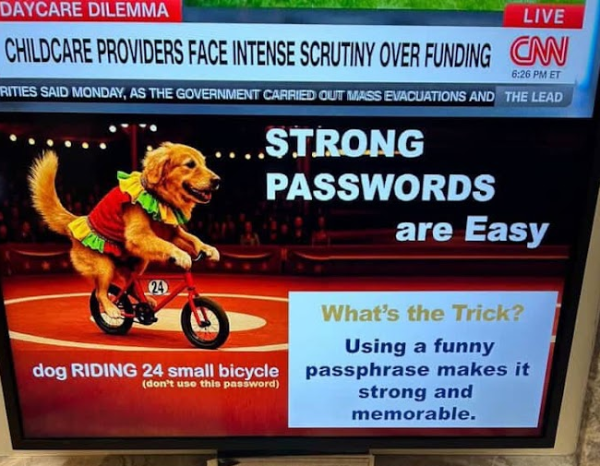
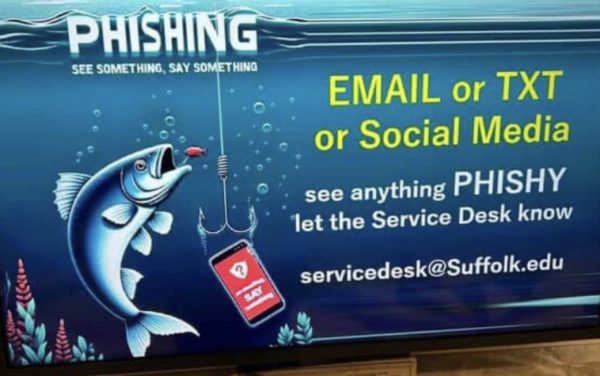
Krystal Lundy, a senior computer science major, broke down the signs of AI use in the two above images, beginning with the dog on the bicycle.
“The reason I immediately caught the dog on a [bicycle] being AI generated was due to the yellow tint produced by it. Lots ofAI models prefer using a warmer tint of color,” said Lundy. “Even ignoring that, the background is a dead giveaway. A lot of people in the audience have extremely weird shapes that don’t make sense.”
Lundy described the signs of AI in the phishing image.
“The dead giveaway lies in the phone used in the image. AI is incredibly bad at writing small text…. If you look closely at the phone you’ll realize that it’s legitimately unreadable.”
Lundy emphasized the importance of using artists instead of AI.
“Pointing out Suffolk using AI is important to me because it’s a situation where our students aren’t getting the chance to show amount of people in their art. That type of opportunity shouldn’t be given to a machine,” said Lundy.
In a statement to The Suffolk Journal, Gatlin said that the university relies on many different images and creative products in its marketing and communication campaigns.
“Including artwork created by employees and students working by hand, with graphic design software, photography, video and with AI tools. All of these are part of a portfolio that helps us share information and tell our story in impactful and creative ways,” said Gatlin.
Other students feel that artists should be utilized instead of AI.
“If it were up to me, we’d either get actual artists or just find images online instead of AI,” said Nana Ampene, a senior entrepreneurship major.
Ollie Lakies, a junior graphic design major, said that Suffolk should use design as a way to get students career-ready.
“Since there’s a bunch of offices that do work studies or scholarship positions for students, utilize us as a resource,” said Lakies. “It would be helpful for art students because it’s something we can put in our portfolio, on resumes.”
Last year, Suffolk had over 1,500 students employed around campus. Almost every department, including art and design, had work study positions available.
Lakies described the thought that goes into design, even in regards to information posts.
“AI makes things so streamlined, and when it comes to design and art, you lose a lot of that personality and nuance,” said Lakies. “I think what a lot of people don’t understand about design is that there’s usually a lot of thought that goes into it, even if it’s just informational posts.”
Lundy also said that AI images removed personality from artwork.
“AI art isn’t just bad because it’s damaging our environment and removing human touch. It’s bad because it takes from artists around the world to generate art. AI art is technically stolen art due to this,” said Lundy. “It steals from millions of artists and it’s ruining nature.”
In 2024, Trystan S. Goetze conducted a study titled “AI Art is Theft: Labour, Extraction, and Exploitation.” It analyzed whether AI image generators rely on theft. The paper concluded that AI relies on “an unethical kind of labour theft.”
“Unlike human processes of borrowing from existing creative works, the process of creating text-to-image AI produces distributive injustices of both material resources and the bases of self-respect,” wrote Geotze.
Geotze specifically noted style theft, defined as “the ability to imitate the styles of specific artists.” This is featured in many text-to-image AI models. He cited Greg Rutkowski, a Polish artist who digitally paints fantasy scenes.
“Rutkowski and other artists claim that they have seen a drop in interest in their work-for-hire as AI image generators gained the ability to make convincing imitations of their style,” wrote Geotze.
Sarah Anderson, a popular internet cartoonist, filed a class-action copyright infringement lawsuit against several AI companies on Jan 12, 2023 because of style theft. On Aug 12 the judge “found both direct and induced copyright infringement claims to be plausible.”
Andersen v. Stability AI will be brought to trial Sep. 8 2026. This legal battle is predicted to set a precedent for the relationship between AI and intellectual property rights.
Lakies said that Suffolk’s brand is impacted when it uses AI images..
“When you use AI to generate graphics, to promote information about the school, you’re also incorporating that into the branding of the school,” said Lakies. “With some of the graphics I’ve seen that are very AI generated, they just look a little sloppy.”
Ashley Hubner, a junior studio art major, said she sees a disconnect between Suffolk and its students on this issue.
“We don’t want AI. Talk to the students. They start implementing all this s— and they never talk to the students,” said Hubner. “It feels like the school doesn’t really care about what the students actually have to say, we’re just moneymakers for them.”
This disconnect has been noticed by other students. Simone Alcindor, a freshman political science and sociology major and Journal writer spoke on how it was not communicated that these images were AI.
“I would maybe be a bit more okay if they had disclosed it, but it’s kind of sketchy that they start doing that without saying anything, because what else are they using it for?” Alcindor said. “Can we know where the university is actually using AI for communications?”
As a class of 2029 senator in the Student Government Association, Alcindor is currently drafting an SGA resolution on the university’s usage of AI. He explained what this resolution would entail.
“[It would be] SGA formally taking a stance of being against using AI in Suffolk University communications, and also disclosing current usage of AI,” said Alcindor. “Actually having public standards from the university on how they’ll use AI.”
Gatlin shared the following statement on Suffolk’s usage of AI in regard to the two shared images.
“We view AI as one of many useful tools, and never as a substitute for authentic voices, storytelling and expression. We encourage our employees and our students to use all these tools as appropriate to the particular context in which they are operating,” said Gatlin.