Editor’s Note: Some sources asked to only be referred to by first name out of concerns for safety.
In the wake of the shocking decision by Fenway Health to end provision of gender-affirming care to individuals under the age of 19 this past October, patients and allies of the organization, which has historically cared for underserved communities, have persisted in expressing their disappointment with the institution.
Protesters gathered around the Brewer Fountain in the Boston Common Feb. 7, braving harsh weather conditions to march up Washington Street to the statehouse.
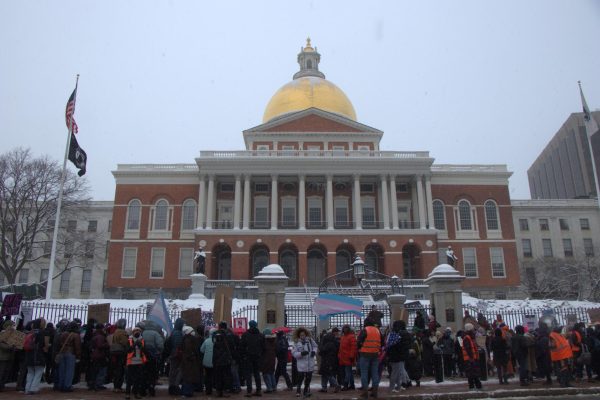
The march was organized by Protect Trans Futures, a coalition dedicated to spreading awareness on attacks to transgender healthcare and other transgender issues. Ahead of the march, there were featured speakers such as civil rights attorney Alejandra Caraballo, queer activist Muhammad Burhan and others.
Organizers shared their four primary demands of the protest:
- Building public clinics as private transgender health clinics are facing loss of grant funding.
- Fund providers who refuse to comply with their institutions that decide to halt care.
- Close the gap in shield laws by having the state legislature pass more of these acts that add personal information protections for both transgender patients and their providers.
- Insist Massachusetts Attorney General Andrea Campbell enforce investigations into potential violations of state level anti-discrimination laws, referencing cases such as the decision by Fenway Health.
Head organizer Teddy Walker described how the Fenway Health decision deviated from his expectations as someone from Texas.
“Everyone said, ‘Go to Massachusetts. Go to the North. That’s where you’ll be safe.’ But this fight is on our doorsteps, it’s in our clinics, it’s on our streets and it’s in our state legislature,” said Walker.
This newfound disappointment in a state once viewed as a sanctuary also evokes worries about adult healthcare, according to advocates and protesters.
Maddie, a protester at the march, described her experience being a newly out transgender adult, detailing how the recent attacks on transgender healthcare are really scary.
“Especially when I’m trying to get on hormones myself, not having any health insurance trying to get help from the state,” Maddie said. “Massachusetts used to be the place to go where you could get [gender-affirming care], and…it’s scary that all that is under attack.”
Alongside continued fundraising efforts to strive towards opening the aforementioned public clinics, Walker spoke about the intended actions of Protect Trans Futures going forward.

“We’re going to keep pressuring the attorney general to enforce civil rights, we’re going to help people access gender affirming care and we’re going to keep connecting with LUCE in our city, we’re going to keep connecting with unions because all of our struggles for liberation are interconnected.”
LUCE is a Massachusetts based immigrant justice network that runs a hotline for reporting Immigrant and Customs Enforcement activity and access to safety resources statewide. The organization has participated in similar gatherings to protest increased ICE presence in recent months.
Through the conversations of fear and uncertainty, the protest was ultimately fulfilling for its participants in more ways than one.
Gabby, a protester from Framingham, said, “The opportunities to both stand up for, in a protest way, but also celebrate queer and trans existence are few and far between it seems, and this is one of them.”
Speaker Elijah Oyenuga highlighted the importance of persistence from the community in these times of uncertainty.
“I cannot tell anyone how to survive fascism. But I will say without a doubt that our enemy is not just the tyrannical administration that seeks to turn us against each other. Our true enemy is the weakness in our hearts that refuses to fight,” said Oyenuga.