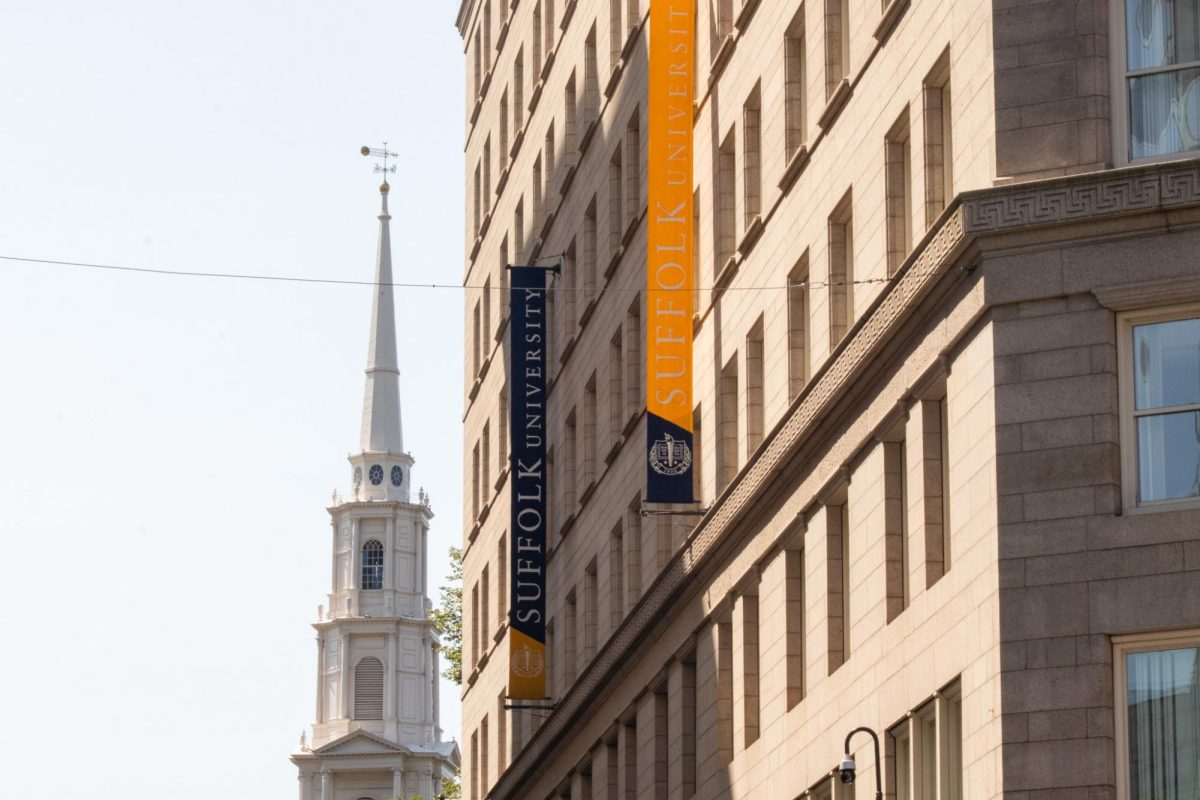
A visit to Suffolk University by a group of staff members from the Scholar Rescue Fund is referenced in the most recent batch of government files on Jeffrey Epstein, a Suffolk Journal review revealed.
The file, which was made public by the United States Department of Justice, includes an email exchange between Daniela Kaisth and Jim Miller, the Institute of International Education’s then vice president of external affairs and executive director, respectively, and psychiatrist Henry Jarecki, a friend of Jeffrey Epstein’s.
Epstein was not included in the original email exchange that outlined a trip to Boston organized by Miller with visits to Harvard, the Massachusetts College of Art and Design and Suffolk University. Jarecki sent an email to Epstein in the exchange following a recount of the trip from Kaisth, which was “part of a regular visit,” the institute’s Senior Vice President of Public Affairs Valerie Dowling wrote in a statement to The Journal.
“Think what a great job we’ve done, getting these 45 pages worth of nitwits out of Iraq and thus giving the country’s junior scholars room to grow into their jobs. Thanks to your help, we’ve massively benefited the country,” Jarecki wrote in the 2010 email to Epstein.
Jarecki was accused of raping a former model multiple times after Epstein referred her to seek mental health care from Jarecki after his own abuse of her. The model voluntarily dropped the lawsuit against Jarecki in April 2025, Reuters reported. Jarecki also signed a 2003 50th birthday book for Epstein, according to the Yale Daily News, and was listed in Epstein’s address book, according to Reuters.
The Institute of International Education is the “first private organization facilitating international exchanges,” according to the global not-for-profit’s website. The institute runs the Scholar Rescue Fund which finances fellowships for “threatened and displaced scholars” to continue their work in the United States. Jarecki was one of three founders of the Scholar Rescue Fund in 2002 and served as a trustee of the institute of International Education until he resigned in 2019.
In another email exchange included in the files from 2009 – prior to the 2010 visit – Jarecki asked Epstein for input on his thoughts for the Fund’s mission statement, including one point written by Jarecki that the Fund aims “to increase the world’s level of knowledge by saving its human repositories,” to which Epstein responded, “these are hardly human repositories of any useful info .. my aunt sadie is a wealth of knowledge in comparision, the WORLDS level of knowledge. . no region town family. or proof that the mission has even met these highly fat goals.”
Kaisth wrote in the email addressed to Jarecki and then institute of International Education CEO Allan Goodman that “it was a real pleasure to see [Jim Miller] in action persuading
universities to take our scholars” before thanking Jarecki and Goodman for “making this great work possible.” Jarecki and Kaisth wrote a book together that was released in 2009 titled “Scholar Rescue in the Modern World.”
In the email from Kaisth, she listed a group of Boston-based Scholar Rescue Fund fellows who were working at several universities, including Harvard and the Massachusetts College of Art and Design. The group of institute staff met with several of these fellows for lunch, but none were from Suffolk.
Suffolk University is listed as a current partnering host institution to the Scholar Rescue Fund on the institute’s website. According to Suffolk University Vice President of Communications Greg Gatlin, Suffolk has no current connection to the fund and has not for more than a decade.
Suffolk University hosted one fellow from the Scholar Rescue Fund during the 2011-2012 academic year and two fellows in 2013-2014, according to the Institute of International Education.
The Suffolk Journal also reported on a 2013 Ford Hall Forum in which Scholar Rescue Fund fellows, including at least one visiting scholar from Ethiopia at Suffolk University, discussed the program and academic persecution overseas less than three years after Institute staff visited Suffolk on the recruitment trip.
Suffolk’s remaining affiliations with the institute include administering the Test of English as a Foreign Language to international students, which is certified by the Institute of International Education, and participation in Fulbright scholars programs, which the institute “administers under a cooperative agreement with the U.S. Department of State,” according to Gatlin.
“To our knowledge, the University never corresponded with Jeffrey Epstein nor was it aware of any donations he provided to the Institute of International Education or any advisory role he may have had with its leaders,” Gatlin wrote in a statement to The Journal.
Epstein gave $435,000 to the Institute of International Education over the course of five different donations from 2002-2006, according to tax data compiled by The Miami Herald in 2019.
The Herald used Epstein’s Form 990s, which are submitted by 501(c)3 charitable organizations yearly to the Internal Revenue Service. This data does not include other private funding that may have come from Epstein to the Institute of International Education.
The first donation to the organization was May 2002 for $250,000 and then a separate donation of $25,000 that same month was recorded. One year later, Epstein gave another $25,000. In June 2005, he gave $35,000, and the final donation documented in this data set was September 2006 for $100,000.
These donations came from two sources: Epstein Interest and C.O.U.Q. Foundation INC.
Epstein’s Interest, also known as the J. Epstein Virgin Islands Foundation, was one of Epstein’s organizations. Marketed as a charity, Epstein used this foundation to “donate” to other people and organizations for years. A 2019 investigation by The New York Times revealed that this organization was deceptive and full of inconsistencies. The C.O.U.Q. Foundation was another one of Epstein’s non-profit corporations that was used to donate money to high profile organizations and individuals.
Even when he wasn’t financially invested with the organization, Epstein provided his opinions for which scholars would be selected to be “rescued” for years. The institute told The Journal that Epstein was never a consultant and his donations were unrestricted to be used for any Scholar Rescue Fund efforts.
In the released Epstein files, numerous additional email exchanges primarily between Epstein and Jarecki outline conversations about the fund’s scholars, often with aggressive and judgmental themes.
In an email Epstein wrote to Jarecki, he critiqued the existing need of one of the scholars sponsored by the Scholar Rescue Fund.
“He is talented, spent 17 years in europe and america, , has been here since 05.. and you are still RESCUING HIM.. ARe you kidding,” the 2010 email said.
Epstein’s close relationship with Jarecki contributed to his ongoing engagement with the institute.
“I know these reports interest you and that you appreciate my regularly keeping you in touch,” Jarecki wrote in a 2012 email to Epstein.
In an email exchange between Epstein and Jarecki in 2010, the two discussed themes of xenophobia, external beauty and nods to eugenics and other problematic ideologies as it pertains to their involvement with the Harvard evolutionary center and the Scholar Research Fund.
“I assume that pirate code would mean you were in for at least what i was in for with srf,, if not true,, please let me know,” Epstein wrote in an email.
Jarecki responded to this by saying, “But the pirate code says, then, that one must reciprocate? Where will I get all the talent that has so usefully been expended on me?”
Later in the email, Jarecki said, “You believe it is good looking greyed men who like lots of young women and have scientific bent and are American and Jewish that have the most talent and merit and are the most aesthetically appealing.”
Jarecki signed off the email, “Heil!”
Epstein died by suicide in prison in August 2019 while he was facing sex trafficking charges.
A letter sent to Epstein in 2010 thanked him for the impact he had made on the Scholar Research Fund. It is unknown who originally sent this message that was forwarded to Epstein by Diana Villabon, an assistant at the wealth management firm that handles the Jarecki family’s investments and philanthropic contributions.
“We appreciate your support, your wisdom, even your constant criticism,” the letter said. “I have no doubt that we will need these invaluable resources again in the future, perhaps much sooner than we would have liked. Thanks to you, we will have them.”
The Journal’s Joseph Dimino, Alexis Crochiere and Jordan Chantha contributed to the reporting of this story.